


Journal
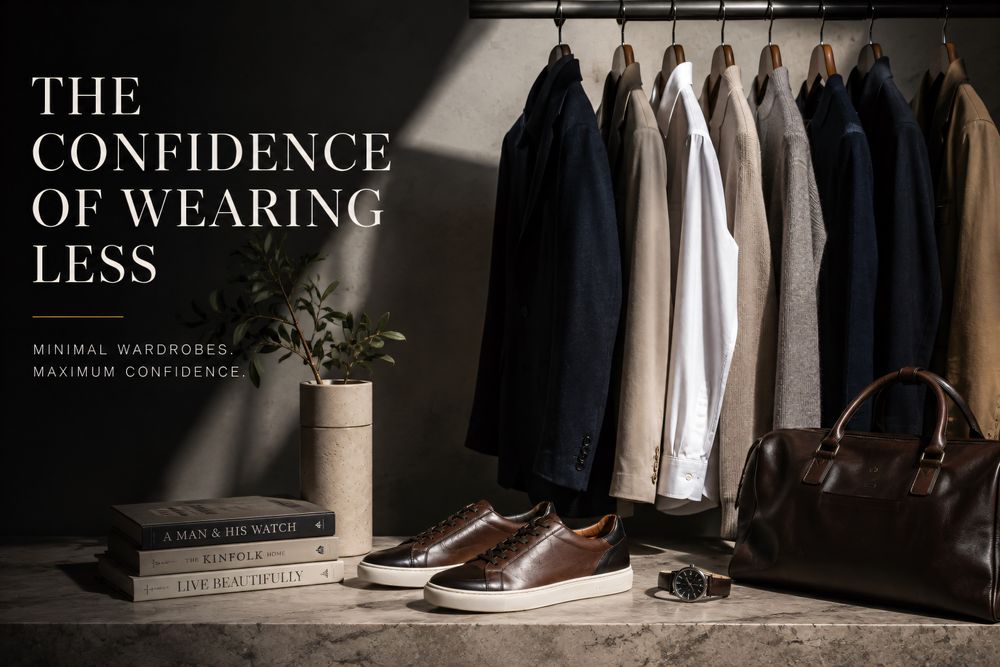
The confidence of wearing less
Why a smaller wardrobe can create a stronger personal style
1st September 2026
There is a peculiar moment that occurs in front of many wardrobes.
The doors open. Inside are shirts, jackets, trousers, knitwear, shoes and various purchases that seemed entirely reasonable at the time. There is enough clothing to survive a lengthy interruption to the global textile industry. Yet, after several minutes of consideration, the conclusion arrives:
There is nothing to wear.
This is obviously nonsense.
There is plenty to wear. The problem is choice.
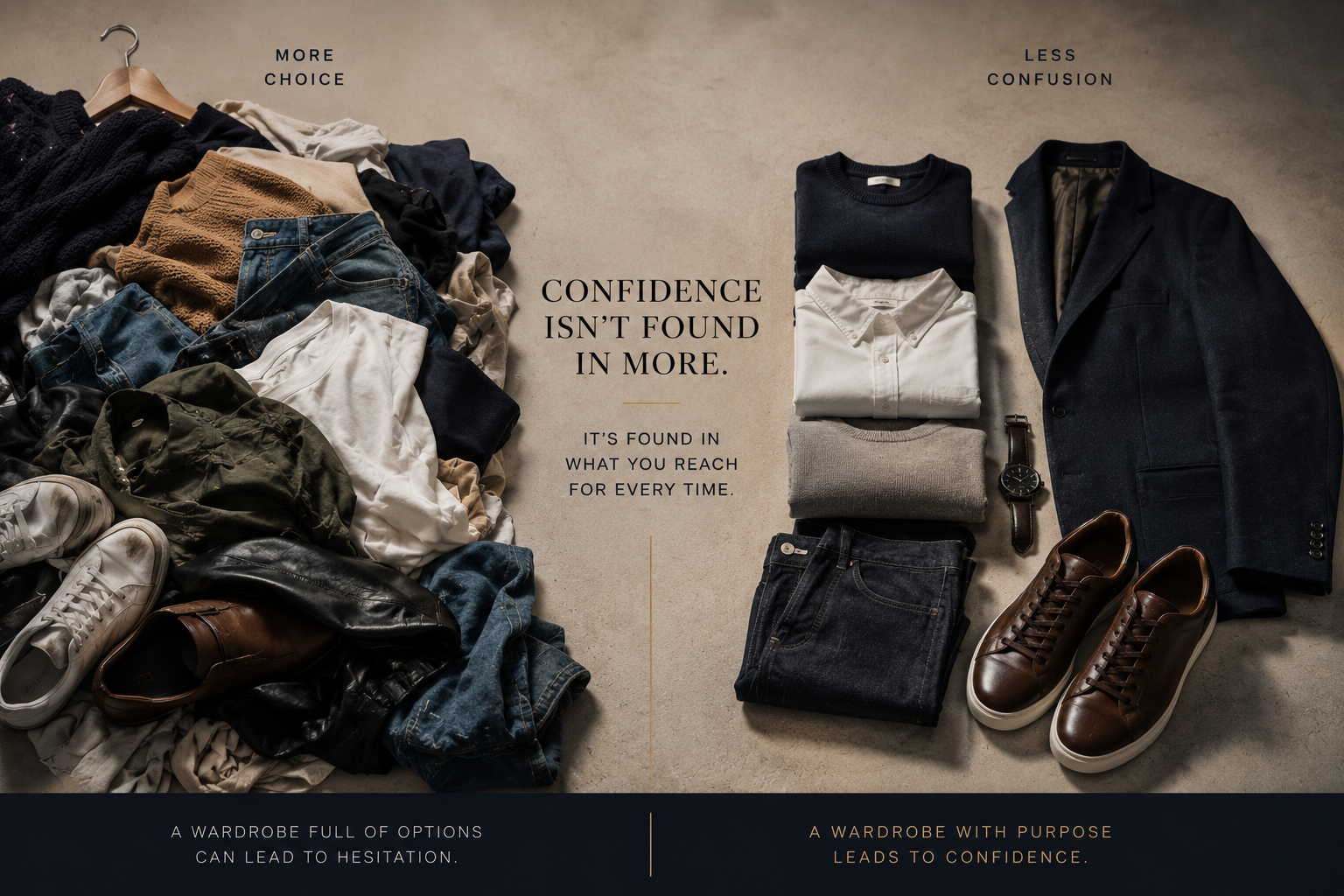
Modern wardrobes have become extraordinarily good at giving us options and surprisingly bad at helping us make decisions. We accumulate alternatives in the belief that they provide freedom, then repeatedly ignore most of them and return to the same small group of clothes that reliably work.
The navy jacket.
The trousers that always fit properly.
The shirt that somehow looks right without requiring negotiation.
The familiar watch.
The sneakers positioned nearest the door because putting them anywhere else would merely delay the inevitable.
This behaviour tells us something interesting about personal style. Despite the enormous importance fashion places on novelty, human beings frequently prefer familiarity. We like knowing something works. We appreciate objects that remove uncertainty. And once we become confident in our preferences, the need to continually prove our taste through new choices often begins to disappear.
That is the real subject of wearing less.
It is not an argument for emptying your wardrobe into bin bags, counting every possession and announcing on social media that you now own precisely four T-shirts and have never felt more spiritually fulfilled. Nor is it an exercise in deprivation disguised as sophistication.
It is about confidence.
Specifically, the confidence that develops when you understand your personal style well enough that more choice no longer automatically feels like better choice.
This is where the idea moves beyond The Anti-Collection: Why One Pair Is Enough. That article questioned the assumption that accumulation necessarily improves ownership. This one begins after that argument has been made. What happens psychologically when we stop feeling compelled to accumulate? Why does repetition sometimes make style stronger rather than weaker? And why can owning fewer, better products actually make getting dressed easier?
The answer begins with an uncomfortable possibility.
Perhaps the best wardrobe is not the one containing the greatest number of possibilities.
Perhaps it is the one in which the greatest number of things feel right.
1. When Choice Stops Feeling Like Freedom
Choice is usually presented as a benefit.
Would you like the jacket in navy, charcoal, olive, camel, black, burgundy or one of three colours with names apparently invented by an interior designer? Would you prefer slim, regular, relaxed or oversized? Smooth leather, pebble grain or suede? White sole or tonal? Seven different versions appear, followed immediately by an invitation to “discover more.”
The assumption is simple: more options increase the likelihood of finding precisely what we want.
Up to a point, they do.
Beyond that point, choice starts requiring work.
Every additional possibility has to be compared with the alternatives. The more alternatives we consider, the easier it becomes to imagine that one of the options we rejected might have been better. Instead of feeling confident about what we chose, we remain slightly haunted by everything we didn’t.
The wardrobe becomes the physical record of these decisions.
This is where decision fatigue enters the conversation. We make a remarkable number of choices throughout an ordinary day, many of them trivial individually but tiring collectively. Clothing adds another set before the day has properly begun.
Which trousers?
Which shirt?
Does this work with that?
Are those sneakers too casual?
Is the weather actually going to be 19 degrees, or is the weather app once again writing speculative fiction?
None of these decisions is especially demanding. Together, however, they create friction.
A confident wardrobe removes much of it.
This does not necessarily mean a small wardrobe. It means a coherent one. If colours work together, silhouettes are compatible and the majority of pieces have been selected around an established personal style, decisions become easier because fewer combinations fail.
The difference is important.
Minimalism says: own less.
Confidence says: need fewer alternatives.
Those are not quite the same thing.
Someone may own thirty beautifully selected pieces and have a stronger functional wardrobe than another person with ten items chosen according to an arbitrary minimalist formula. Equally, someone may own 150 pieces but rely almost entirely on fifteen of them.
The number is not particularly interesting.
The behaviour is.
As explored in The Luxury of Knowing Exactly What You Like, mature personal taste eventually becomes an editing mechanism. You begin eliminating possibilities almost automatically because experience has taught you what works.
You don’t need to try the dramatically oversized jacket because you already know you dislike the silhouette.
You don’t need another pair of bright trainers because every previous pair has spent its life looking extremely colourful inside a dark cupboard.
You don’t need the fashionable trouser shape that requires replacing half your existing wardrobe to make it work.
Choice remains available.
You simply become better at ignoring it.
That is an underrated form of freedom.
2. The Wardrobe Full of Clothes With Nothing to Wear
The phrase “nothing to wear” rarely means what it says.
Usually, it means “nothing here feels right today.”
That distinction explains why wardrobes can expand without becoming more useful.
Clothes enter for all sorts of reasons. Some solve genuine needs. Others are bought because they looked excellent on somebody else. Some represented a temporary enthusiasm for a colour or style. Others were purchased for an imaginary future self who apparently attends considerably more cocktail parties, country weekends and art-gallery openings than the real one.
Then there are bargains.
Bargains occupy a special category because they allow us to congratulate ourselves for saving money while spending it.
A £300 jacket reduced to £120 can feel like £180 of financial brilliance right up until the moment we realise we never wear it.
This is one of the fundamental problems with measuring wardrobes by quantity. Ownership tells us remarkably little about usefulness.
Wear frequency tells us considerably more.
Observe what you actually choose for a month and patterns quickly appear. Certain trousers return repeatedly. A handful of shirts dominate. One jacket solves numerous situations. Two or three pairs of shoes carry most of the workload.
The rest may still be valuable. Occasion-specific clothing naturally gets used less frequently. Formalwear cannot reasonably be expected to compete with everyday knitwear on annual appearances unless one’s social life is considerably more exciting than average.
But there is usually a substantial middle ground populated by things that could be worn and somehow never are.
Why?
Often because they create friction.
The colour is slightly difficult.
The fit requires the right trousers.
The shoes only work with one particular outfit.
The jacket is attractive but somehow never quite comfortable.
Individually, none of these problems justified returning the purchase. Collectively, they explain why the object remains unused.
This is where versatility becomes more valuable than novelty.
The best wardrobe pieces do not merely look good independently. They cooperate.
A pair of understated leather sneakers that works with denim, chinos and relaxed tailoring is useful because it removes decisions rather than creating them. This is the principle behind The Silence of a Good Outfit Starts at Your Feet: versatile footwear supports the wardrobe rather than demanding that the wardrobe reorganise itself around the footwear.
That difference becomes increasingly important when we start wearing less.
Every product has to earn more of its space.
A jacket worn twice a year may be beautiful. A jacket worn twice a week becomes part of your life.
And once we begin evaluating clothes by how naturally they fit into our actual lives rather than how attractive they seemed at the point of purchase, the wardrobe starts becoming considerably more honest.
3. Your Real Wardrobe Is Smaller Than You Think
There are really two wardrobes in most homes.
The first is the physical wardrobe: everything hanging from the rail, folded into drawers or occupying the mysterious chair on which clothes are neither clean enough to put away nor dirty enough to wash.
The second is the behavioural wardrobe.
This consists of what you actually wear.
The second is usually much smaller.
This phenomenon is useful because it means many people already practise a form of wardrobe minimalism without deliberately doing so. They simply haven’t removed the unused pieces surrounding it.
Think about packing for a trip.
Travel has an extraordinary ability to expose what matters. Faced with a limited suitcase, we suddenly become ruthless editors. The slightly difficult trousers stay home. The jacket that only works with one shirt does not make the cut. Shoes have to justify their volume.
What survives?
Usually the things we trust.
The familiar knitwear. The versatile trousers. The shirt that works day and evening. The sneakers comfortable enough for an airport but smart enough for dinner.
For a week or two, we live with a dramatically smaller wardrobe.
And frequently, nothing terrible happens.
In fact, getting dressed can become easier.
This suggests that variety and satisfaction are not directly proportional. A wardrobe does not necessarily become twice as useful when its contents double.
Often, the opposite occurs.
The behavioural wardrobe develops naturally around four characteristics: comfort, compatibility, familiarity and confidence.
Comfort is obvious. If something is physically irritating, it will eventually lose against something that isn’t.
Compatibility matters because clothes do not exist independently. The more easily an item works with the rest of the wardrobe, the more opportunities it has to be worn.
Familiarity develops through repetition. We know how the piece behaves and what works with it.
Confidence is the final layer. We stop wondering whether we look right because experience has already answered the question.
This creates a feedback loop.
We wear something because it works.
Because we wear it, it becomes familiar.
Because it becomes familiar, we become more confident wearing it.
Because we feel confident wearing it, we choose it again.
This is one reason cost-per-wear can reveal far more about genuine value than the original price tag. Jasperosso explored this directly in The Cost-Per-Wear Fallacy: Why Expensive Sneakers Are Often the Smartest Buy. A cheaper product that spends almost all its life unused can ultimately represent poorer value than an expensive one that becomes a weekly default.
The mathematics is straightforward.
The psychology is more interesting.
The things we wear most often are not necessarily those we were most excited about buying.
Excitement is strongest at acquisition.
Utility reveals itself afterwards.
That difference matters enormously when building a smaller, more confident wardrobe.
4. The Psychology of the Personal Uniform
The word uniform has terrible public relations.
It implies conformity, restriction and perhaps an unpleasant memory involving a school blazer several sizes too large because somebody insisted you would “grow into it.”
Yet voluntary uniforms are something else entirely.
A personal uniform is simply a set of aesthetic principles repeated often enough that getting dressed becomes intuitive.
For one person, that might mean navy trousers, fine knitwear and leather sneakers. For another, jeans, Oxford shirts and an unstructured jacket. Someone else might prefer monochrome clothing with one consistent accent colour.
The individual items can change.
The underlying language remains recognisable.
This is not laziness.
It can be the consequence of considerable experimentation.
You try different shapes, colours and combinations over years. Some work. Others provide photographic evidence that personal development is real. Gradually, the successful elements remain while the unsuccessful ones disappear.
Eventually, you establish a formula.
Fashion sometimes treats this as surrender. If clothing is creative expression, surely repeating a formula represents a failure to keep creating?
Not necessarily.
Musicians develop recognisable sounds. Architects return to particular proportions and materials. Chefs develop culinary signatures. Nobody argues that a painter has run out of imagination because their work possesses a recognisable visual language.
Why should personal style operate differently?
Repetition is often how identity becomes visible.
The same principle appears in What Your Sneakers Say When You're Not Speaking. Personal style communicates through consistent choices rather than isolated performances. A single unusual outfit tells us relatively little. What somebody chooses repeatedly reveals much more.
The personal uniform also solves a practical problem: it reduces cognitive load without eliminating individuality.
If you know that a particular trouser shape works, there is no need to reassess trouser architecture every morning. If your footwear reliably works across most of your wardrobe, the shoe decision becomes almost automatic. If your colours already complement one another, combinations require less calculation.
This is quiet confidence in practical form.
You are not dressing identically because you cannot imagine alternatives.
You are repeating principles because you have tested the alternatives.
There is an enormous difference.
5. Confidence Doesn’t Need a New Outfit
There is a curious cultural assumption that important occasions require new clothes.
Wedding invitation?
New outfit.
Important dinner?
Perhaps a new jacket.
Big presentation?
Something new might make us feel more confident.
There is an obvious emotional logic to this. New clothes can provide novelty, and novelty can create a temporary sense of transformation. We put something new on and feel slightly different.
Sometimes that is exactly what we want.
But newness can also introduce uncertainty at precisely the moment we would prefer to remove it.
The trousers fit beautifully in the changing room, but how will they feel after four hours?
The new shoes looked excellent at home, but will they still feel excellent after walking across London?
The jacket works in front of the bedroom mirror, but are we actually comfortable wearing it?
Familiar clothes carry none of these questions.
They have already been tested.
This is why genuine confidence can often be found in repetition rather than novelty. The person who knows exactly which jacket, trousers and shoes make them feel comfortable has one less thing to think about when the occasion itself demands attention.
The clothes become support rather than performance.
This is particularly important with footwear because physical discomfort is unusually effective at destroying psychological composure. It is difficult to project effortless confidence while privately negotiating with a blister.
Familiar footwear offers certainty.
You know how it feels after an hour.
You know how it moves.
You know which trousers work with it.
You know whether you can walk several miles without beginning to resent both the shoes and the person who suggested walking.
This relationship between familiarity and confidence is part of the wider psychology of dressing explored in The Psychology of Wearing: How Your Shoes Influence How You Move Through the World. What we wear does not merely change how other people see us. It can influence how comfortable, natural and self-conscious we feel ourselves.
The confident wardrobe therefore becomes less dependent upon occasion-specific reinvention.
Instead of asking, “What should I buy for this event?” the question becomes, “What do I already own that I know works?”
That small shift is surprisingly significant.
It moves clothing away from performance and towards identity.
And it points towards the second half of this argument.
Because once we stop requiring constant novelty, something else changes. Quality becomes more important.
If we are going to wear fewer things more often, those things need to justify the repetition. Materials matter more. Construction matters more. Comfort matters more. Versatility matters more. The difference between an object designed to survive occasional use and one intended to become a long-term companion becomes increasingly obvious.
Wearing less does not mean caring less about clothes.
Quite often, it means caring considerably more about the clothes that remain.
And that is where the economics of a smaller wardrobe begin to become surprisingly luxurious.
6. Fewer Things Make Better Things More Important
There is an obvious consequence to owning fewer things: each thing matters more.
If someone owns twenty pairs of everyday shoes, no individual pair has to work particularly hard. One can be slightly uncomfortable, another difficult to coordinate, another suitable only when the weather behaves itself. Their shortcomings are absorbed by the collection.
Reduce those twenty pairs to four or five genuinely useful ones and the requirements change.
Each pair needs to perform.
The same applies throughout a wardrobe. A jacket worn twice a year can survive being slightly awkward. One worn twice a week needs to fit beautifully, feel comfortable and work with a substantial proportion of everything else you own. A shirt that appears occasionally can be temperamental. The one you instinctively reach for every few days cannot.
This is where the idea of “fewer, better things” becomes more than an attractive phrase.
Quality becomes functional.
Materials matter because they are going to experience repeated use. Construction matters because the object needs to survive it. Comfort becomes essential because minor irritations become major ones when encountered several times each week. Versatility matters because every item has more situations to cover.
Most importantly, design matters because you are going to look at the object frequently.
A highly fashionable detail can be exciting when encountered occasionally. Repeated fifty or a hundred times, it may become considerably less charming. Restrained design often performs better under repetition because it leaves space for the wearer rather than insisting upon being the central event every time it appears.
This connects directly with The Beauty of Restraint. When unnecessary elements are removed, materials, proportions and craftsmanship have nowhere to hide. A simple object made badly feels cheap. A simple object made exceptionally well can reveal more with every use.
Footwear demonstrates this particularly clearly.
Consider two leather sneakers from a distance. Both might have relatively clean silhouettes. Both might use restrained colours. Both may initially appear similar.
Then ownership begins.
The quality of the leather becomes apparent in the way it flexes and ages. The construction reveals itself through durability. The lining matters after several hours of wear. The shape determines whether the sneaker continues feeling balanced after hundreds of outings. Small differences that were difficult to appreciate in a photograph become significant through repetition.
This is why a smaller wardrobe can change the way we evaluate luxury.
Instead of asking, “How impressive does this look when I buy it?” we begin asking, “How good will this be to live with?”
That is a much harder question.
Luxury has traditionally been excellent at the first one. Beautiful packaging, pristine boutiques and carefully controlled presentation can turn acquisition into theatre.
Long-term ownership is less forgiving.
The box eventually disappears into a cupboard.
The ribbon has done its job.
Now the product has to perform.
This is where craftsmanship earns its value. As explored in Why Handmade Still Matters in an Automated World, human craftsmanship is not valuable merely because hands were involved. It matters when skill, judgement and material knowledge create an object capable of rewarding repeated use.
If you intend to wear something frequently, these qualities cease to be abstract.
They become practical.
Fewer products therefore do not necessarily mean spending less on every purchase.
They may mean becoming considerably more demanding about what deserves to be purchased at all.
7. Repetition Is How Personal Style Becomes Recognisable
There is a strange pressure in fashion to avoid being seen in the same thing too often.
Social media has intensified it. When outfits become content, repetition can appear suspiciously like a shortage of new material. Clothing starts behaving less like something we live in and more like something requiring constant updates.
Real life is rather different.
People who develop recognisable personal style almost always repeat themselves.
They return to similar colours.
They favour familiar proportions.
They wear the same watch.
They choose similar jackets.
They discover that brown suede has apparently become a permanent member of the family.
This repetition is not a failure of creativity.
It is how signatures develop.
The principle is explored more fully in The Objects That Quietly Define Us. We become associated with objects and styles not because we wear them once, but because we choose them repeatedly until other people begin connecting those choices with us.
A personal signature cannot exist without repetition.
Imagine someone wears a striking burgundy sneaker once.
You might remember the sneaker.
If they repeatedly wear beautifully understated sneakers incorporating burgundy details over several years, you may begin associating burgundy footwear with the person.
The object has become part of a pattern.
This is one reason a smaller wardrobe can actually produce a stronger personal identity. When fewer things are worn more frequently, preferences become more visible.
The colours recur.
The silhouettes recur.
The materials recur.
The individual develops continuity.
Contrast this with a wardrobe built primarily around novelty. Monday might be minimalist, Tuesday streetwear, Wednesday heavily branded luxury and Thursday an enthusiastic interpretation of whatever happened to appear online the previous weekend.
There is nothing inherently wrong with this. Experimentation can be enjoyable.
But experimentation and identity are different things.
One explores possibilities.
The other establishes preferences.
As personal style matures, many people naturally move from the first towards the second. They still experiment, but new ideas are filtered through an increasingly established understanding of themselves.
This is where bespoke design becomes interesting.
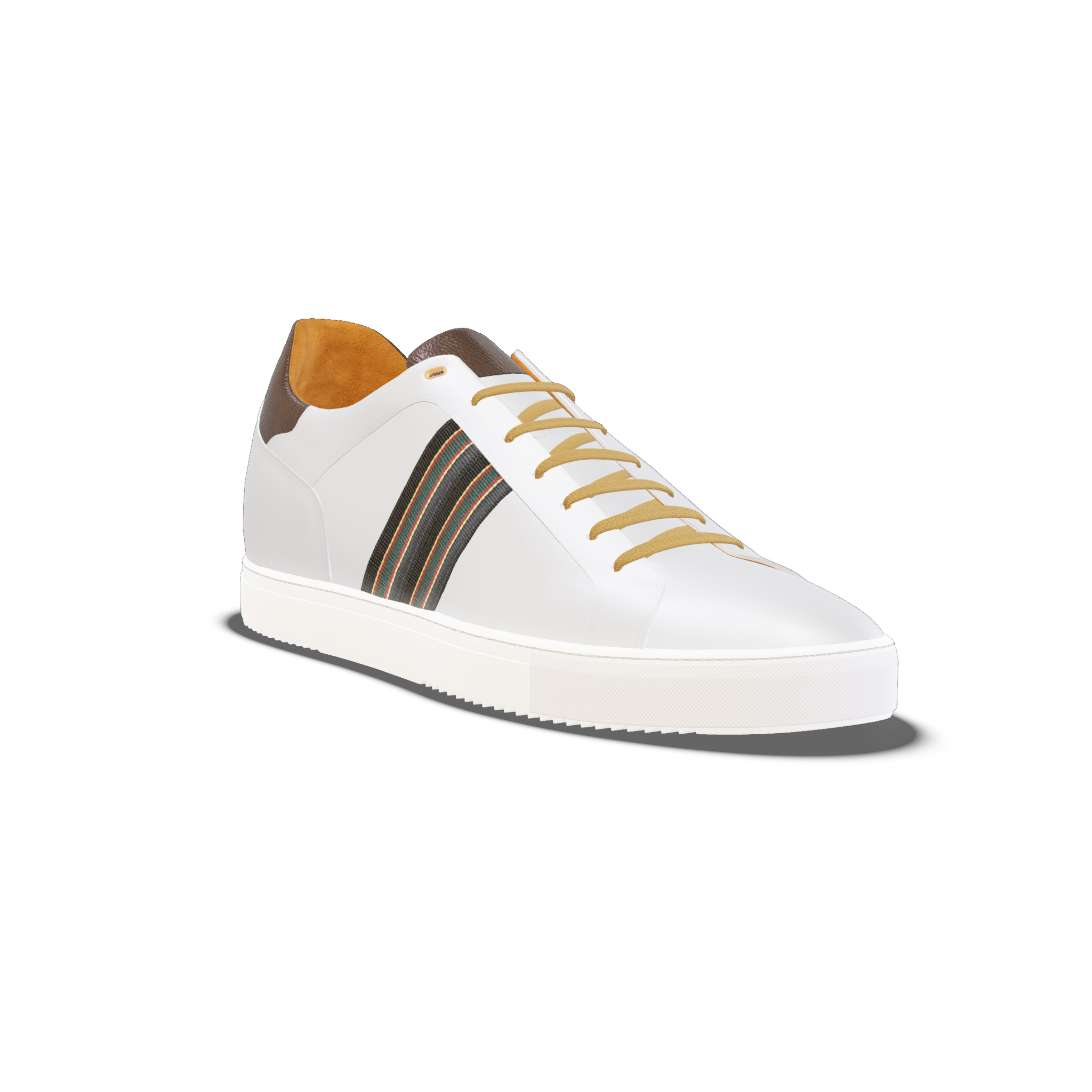
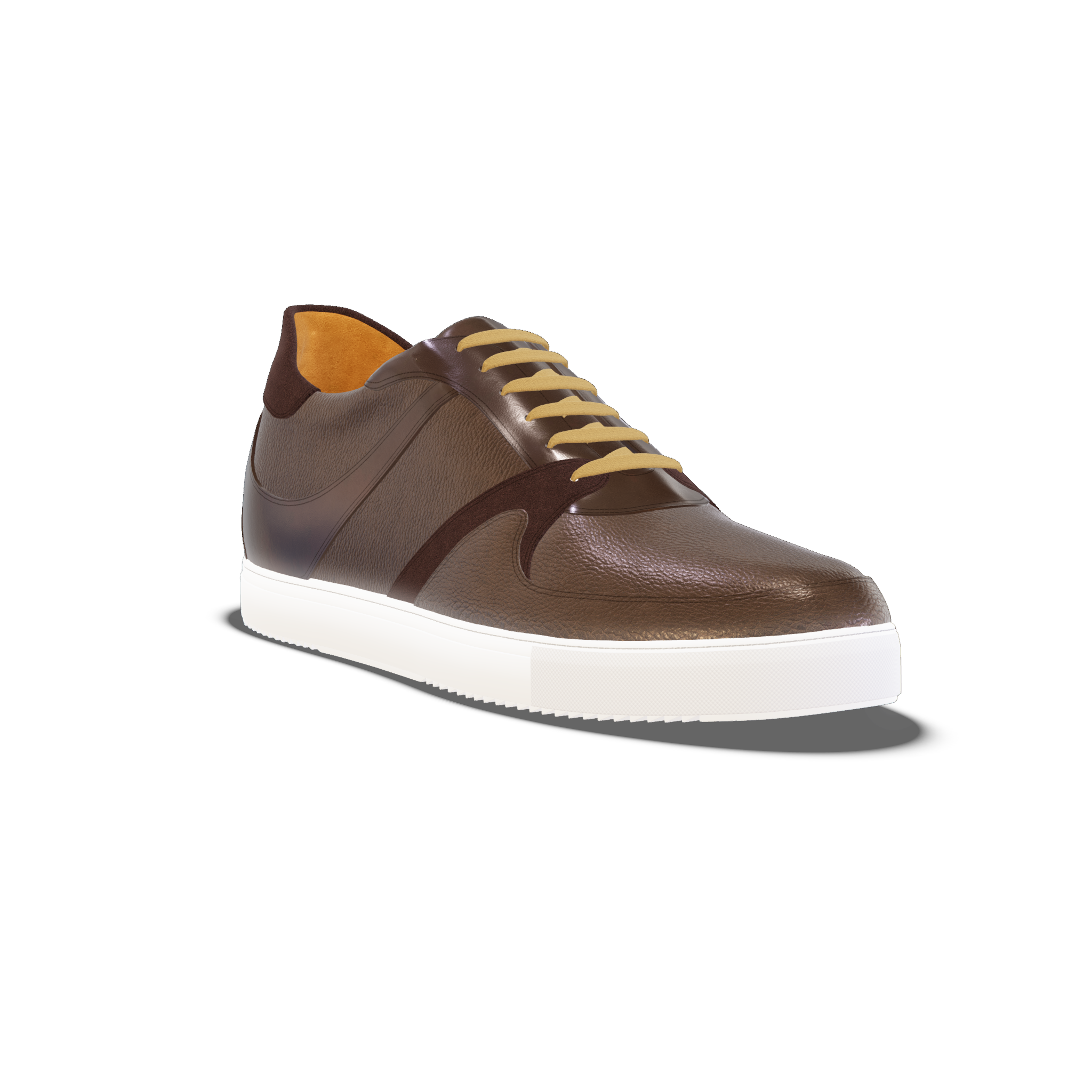
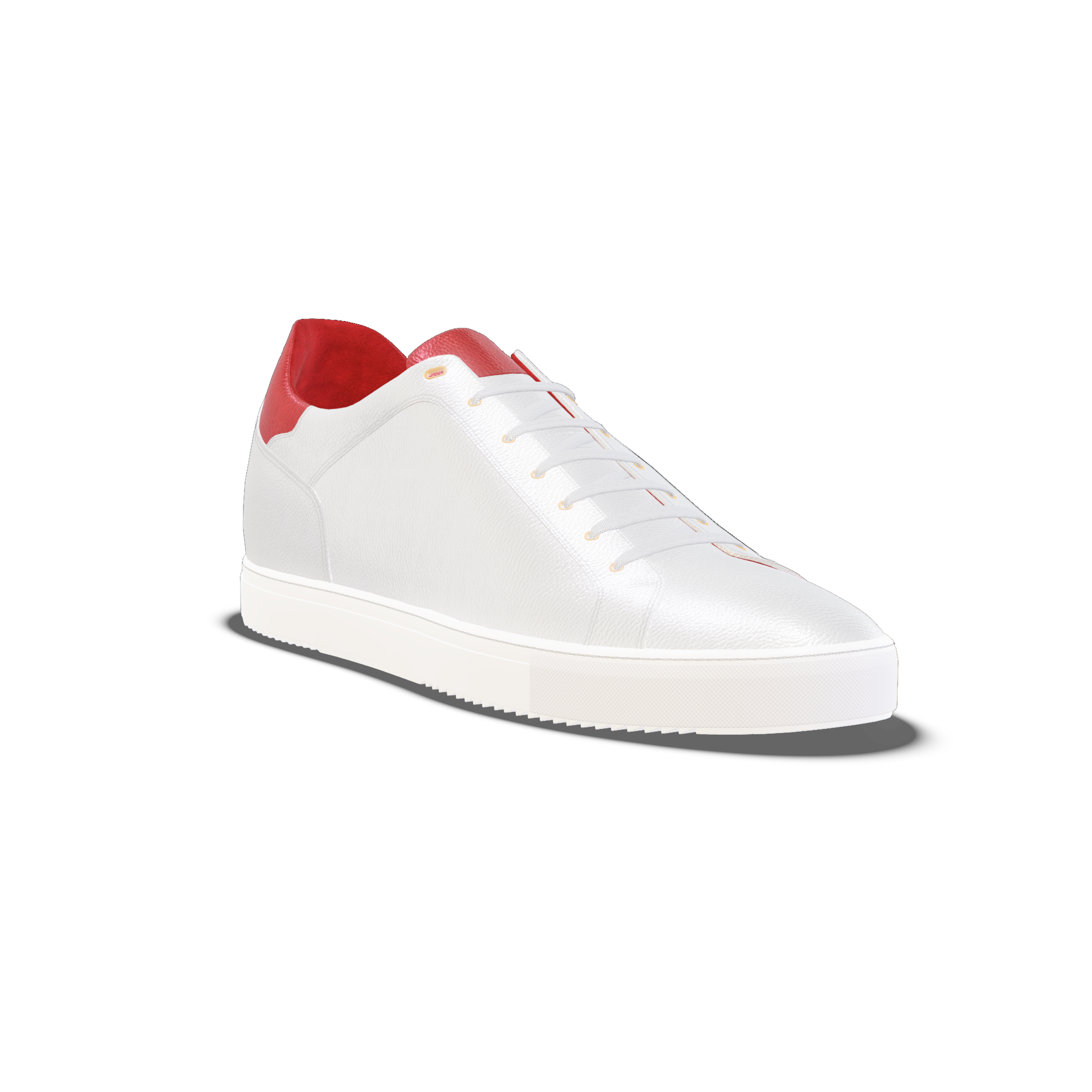
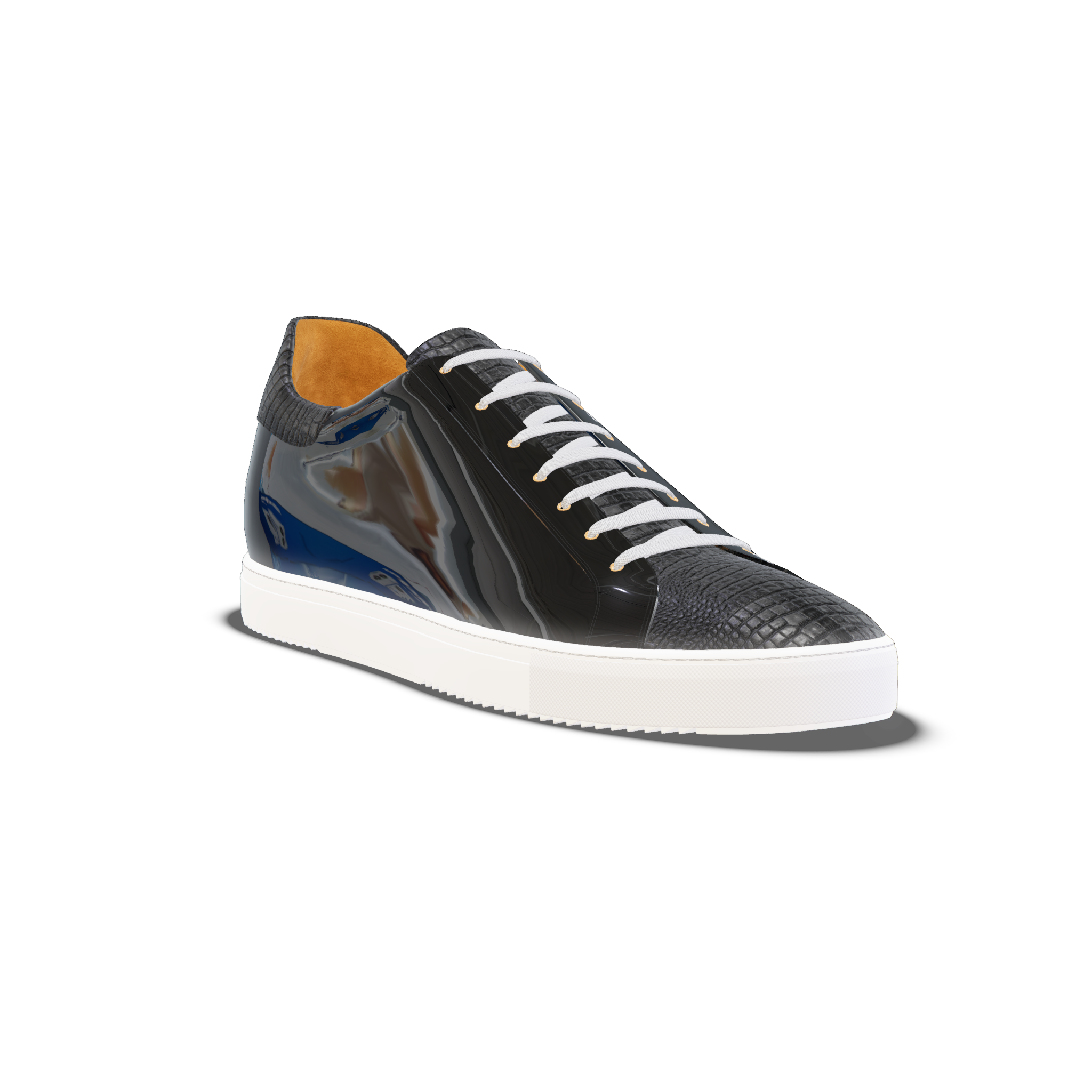
If you already know that you consistently wear navy, brown, charcoal and cream, the ability to choose your own sneaker materials does not need to result in something dramatically different. It may simply allow you to create a more precise version of what you already know works.
Perhaps the upper uses chocolate pebble-grain calf with tonal suede. Perhaps navy smooth leather is combined with a slightly darker textured panel. The design can be individual without announcing its individuality from across the street.
The objective is not to create the sneaker nobody else could possibly wear.
It is to create the sneaker you will actually keep wearing.
That distinction is central to confidence.
8. The Quiet Confidence of Not Keeping Up
One of the clearest signs of mature taste is the ability to see something new, appreciate it and do absolutely nothing.
This is harder than it sounds.
Modern commerce is extraordinarily sophisticated at converting awareness into desire. A new silhouette appears. A colour becomes fashionable. A collaboration sells out. An influential person wears something. Suddenly an object that did not exist in our consciousness last Tuesday begins to feel strangely necessary by Friday.
Fashion has always worked partly through novelty, but the speed has changed.
We no longer encounter trends primarily through seasonal magazines or occasional visits to shops. They arrive continuously through phones. The distance between discovering something and purchasing it can be measured in seconds.
This creates an environment in which standing still can feel like falling behind.
Yet personal style does not require constant movement.
Someone confident in their preferences can observe fashion without treating it as an instruction manual. They can admire an oversized silhouette while recognising that they prefer something more tailored. They can appreciate brightly coloured sneakers while continuing to wear brown suede. They can acknowledge that a particular trend looks excellent on somebody else without concluding that it therefore belongs in their own wardrobe.
This is not conservatism.
It is discrimination.
The distinction matters because refusing a trend merely because it is fashionable is just as externally controlled as following it merely because it is fashionable. In both cases, somebody else’s choices are determining yours.
Confidence means evaluating the thing itself.
Do I actually like it?
Will I wear it?
Does it work with what I already own?
Will I still want it after the novelty disappears?
These are deceptively powerful questions.
They interrupt the mechanism that turns exposure into acquisition.
This is particularly relevant to luxury products because the financial consequences of impulsive experimentation become larger. A £40 fashion purchase that proves unsuccessful is irritating. A £400 or £4,000 one provides a more memorable lesson.
It is also why The End of Seasonal Footwear challenges the idea that well-made products should be governed entirely by short fashion cycles. If something has been designed and constructed to last for years, its aesthetic relevance should ideally operate on a similar timescale.
The confident wardrobe therefore becomes somewhat insulated from fashion without becoming disconnected from it.
New ideas still enter.
But they have to earn admission.
There is a useful test here.
Imagine the item were not currently fashionable.
Would you still want it?
If the answer is yes, there is a reasonable chance you genuinely like it.
If the answer is no, you may simply like the fact that everybody else currently likes it.
Those are very different purchases.
The freedom to recognise the difference is one of the quieter pleasures of established taste.
9. Buy Less. Choose More Carefully. Wear More Often.
There is a simple equation at the centre of a more considered wardrobe:
Buy less. Choose more carefully. Wear more often.
None of these ideas is especially radical independently.
Together, they fundamentally change the economics of clothing.
Suppose one pair of sneakers costs £425.
Viewed only at the checkout, £425 is expensive. There is no useful reason to pretend otherwise.
Now suppose those sneakers are worn 150 times.
The purchase cost works out at approximately £2.83 per wear.
Wear them 300 times and the figure falls to roughly £1.42.
Compare that with a £120 pair bought because they were discounted, worn eight times and then largely forgotten.
That pair has cost £15 per wear.
Cost per wear is not a perfect measure. It cannot quantify pleasure, craftsmanship, environmental impact, sentimental value or the simple fact that occasionally we buy something because we love it and do not particularly want to construct a spreadsheet before leaving the house.
But it reveals an important flaw in the way we instinctively think about price.
We tend to evaluate expense at the moment money changes hands.
Value unfolds through ownership.
This distinction is central to The Gap Between Price and Value. An expensive product can represent poor value if it disappoints, deteriorates prematurely or rarely gets used. Equally, something carrying a higher initial price can become excellent value when it performs repeatedly over a long period.
The key variable is use.
This is where personalisation can have an interesting economic consequence.
A product designed around your established preferences may have a greater chance of being worn frequently because it already fits your wardrobe. You have chosen the colour. You understand the materials. You know which trousers and jackets it needs to work with.
Personalisation does not guarantee value.
A badly considered custom design can become a very expensive monument to an enthusiastic evening spent experimenting with colour combinations.
But considered personalisation can reduce compromise.
Instead of buying the nearest available approximation of what you wanted, you create something closer to the original idea.
For Jasperosso, this is the point of offering a broad choice of Italian leathers, colours and textures through the three dimensional design studio. The value is not in using as many options as possible. It is in selecting the combination likely to remain relevant to the person who will actually wear it.
This returns us to the central philosophy of wearing less.
Every purchase should have a reason to exist alongside what you already own.
Not a marketing reason.
Not a trend reason.
A practical and personal one.
Does it solve something?
Does it replace something?
Does it work with your wardrobe?
Will you genuinely choose it repeatedly?
If the answer to the final question is uncertain, the purchase deserves more thought.
Luxury should not merely survive long enough to be worn repeatedly.
It should make you want to repeat the experience.
10. When Enough Becomes a Luxury
There is one word modern consumer culture handles rather badly.
Enough.
Almost everything around us is designed to suggest its opposite.
There is another version.
Another colour.
Another season.
Another upgrade.
Another product that performs approximately the same function as one we already own but possesses a sufficiently different detail to make comparison temporarily interesting.
This is not necessarily sinister. Businesses exist partly because people want new things, and novelty is genuinely pleasurable. There is nothing morally superior about refusing to buy a jacket you love simply because another jacket already exists in your wardrobe.
The problem is not wanting more.
It is never being able to recognise when more adds nothing.
This is where enough becomes unexpectedly luxurious.
Enough means opening a wardrobe and finding that most things work.
Enough means not needing an emergency shopping trip before an important dinner.
Enough means seeing something desirable and being able to distinguish admiration from need.
Enough means knowing that another pair of shoes might be beautiful without automatically being more useful than the pairs you already own.
This is not deprivation.
It is satisfaction.
And satisfaction is commercially inconvenient because satisfied people are difficult to hurry.
They can wait.
They can compare.
They can reject.
They can commission something made properly rather than buying whatever happens to be immediately available.
They can spend more on one object because they have decided not to spend repeatedly on several compromises.
This is where wearing less becomes connected to luxury in a way that has very little to do with minimalism.
Luxury becomes time.
Time to choose.
Time to make.
Time to own.
Time to wear something sufficiently often that it becomes familiar.
As explored in The Luxury of Waiting, immediate availability is not always the highest expression of service. In some categories, waiting exists because the product does not exist until someone has decided exactly what should be made.
That idea runs counter to much of modern retail.
We have become accustomed to wanting something today and receiving it tomorrow. Convenience is extraordinary, but it can also make products feel transient. The distance between desire and ownership becomes so short that there is barely time to consider whether the desire was particularly important in the first place.
Made-to-order luxury introduces friction.
Deliberate friction.
You choose.
You commit.
Someone makes.
You wait.
Then the object arrives.
For a wardrobe built around fewer, better things, that slower rhythm makes sense.
Purchases become events rather than reflexes.
A Smaller Wardrobe Can Have a Bigger Identity
There is a misconception that reducing variety inevitably reduces individuality.
It can do precisely the opposite.
Imagine two wardrobes.
The first contains an enormous range of styles accumulated over years. Some are fashionable, some formal, some sporty, some experimental. There are many possibilities but relatively little connecting them.
The second contains fewer pieces. The colours relate to one another. Materials recur. Silhouettes have a recognisable consistency. Footwear works across multiple combinations. Almost everything reflects the same person’s preferences.
Which wardrobe says more about its owner?
Usually, the second.
Identity becomes clearer through repetition.
This is why The Objects That Quietly Define Us matters as a companion to this argument. We become known for what we repeatedly choose, not for everything we theoretically could have chosen.
The same watch.
The familiar jacket.
The notebook.
The sneakers.
None has to be extraordinary independently.
Together, repeated over time, they create continuity.
And continuity is one of the foundations of style.
The Confidence to Repeat Yourself
Perhaps the greatest obstacle to wearing less is not practical at all.
It is the fear of repetition.
We have been taught to associate variety with creativity. New outfits suggest effort. Repetition can be interpreted as having run out of ideas.
But personal style is built on repetition.
You cannot develop a signature without repeating something.
The interesting dresser is not necessarily the person who looks completely different every day. Often, it is the person whose choices remain recognisably theirs regardless of what they are wearing.
That requires consistency.
A colour returns.
A silhouette returns.
A texture returns.
A type of footwear returns.
Eventually, those repetitions stop looking repetitive and start looking intentional.
This is precisely what happens in other creative disciplines. We recognise a photographer’s work because certain visual ideas recur. We recognise an architect because particular relationships between space and material return. We recognise a musician because there is continuity beneath different compositions.
Nobody tells them they should try becoming somebody completely different every Tuesday.
Personal style deserves the same latitude.
Confidence is being willing to repeat yourself because the repetition is deliberate.
Conclusion: Less Choice, More Certainty
The strongest argument for wearing less is not environmental, economic or aesthetic, although each can support it.
It is psychological.
A confident wardrobe removes unnecessary uncertainty.
You know what works.
You know what fits.
You know which colours belong together.
You know which materials you enjoy wearing.
You know which sneakers can carry you from an ordinary morning through an unexpected evening without requiring a change of identity halfway through the day.
The wardrobe becomes easier because you have already made the difficult decisions.
This is why wearing less should not be confused with owning as little as possible.
There is no ideal number.
Twenty pieces may be sufficient for one person and absurdly restrictive for another. Someone who moves between climates, professions and formal environments will naturally require more variety than someone whose life has fewer clothing demands.
The objective is not reduction for the sake of reduction.
It is clarity.
This takes us back to The Anti-Collection: Why One Pair Is Enough. The point was never literally that everybody should own one pair of shoes. It was to challenge the assumption that satisfaction automatically increases alongside quantity.
The Confidence of Wearing Less takes the argument further.
Once we stop measuring a wardrobe by how many possibilities it contains, we can begin measuring it by how many of those possibilities genuinely work.
That changes how we buy.
Fewer compromises become acceptable.
Quality becomes more important.
Craftsmanship becomes practical rather than decorative.
Personalisation becomes a means of precision rather than excess.
And familiarity stops looking boring.
It starts looking like confidence.
Perhaps that is the ultimate difference between someone still searching for their style and someone who has found it.
The first person needs options.
The second needs choices they trust.
There will always be another collection, another trend and another object worth admiring. Some of them may deserve a place in our lives.
Most won’t.
The confidence lies in knowing the difference.
Because the best wardrobe is not necessarily the one that gives you something different to wear every day.
It is the one where, almost every day, what you already own feels exactly right.
By Jasper Trumble