


Journal
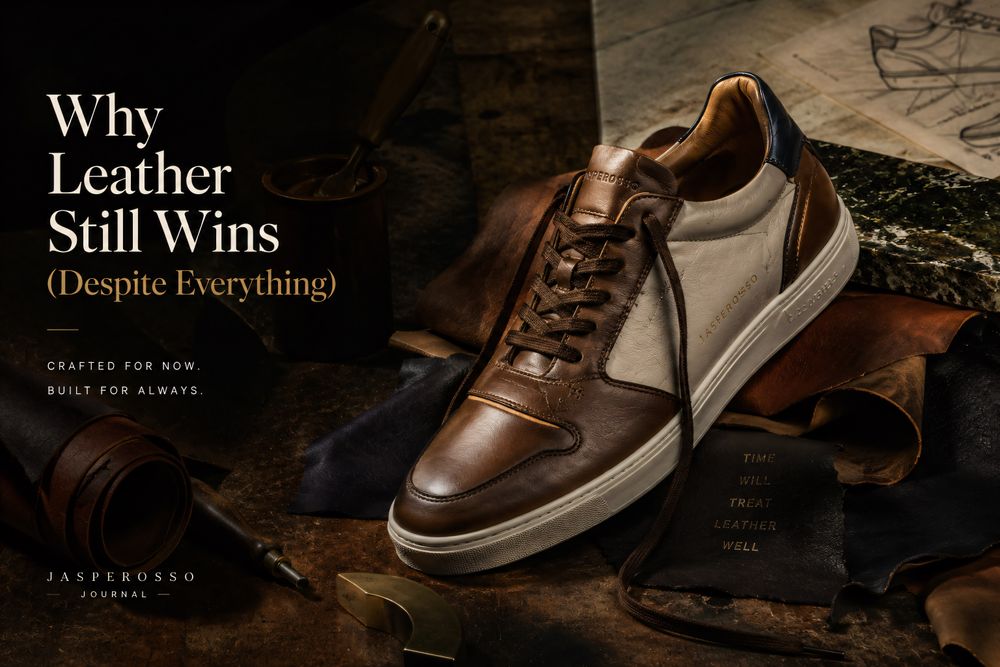
Why Leather Still Wins (Despite Everything)
18th May 2026
There are certain debates in modern luxury that seem to return with remarkable predictability. Quiet luxury versus statement fashion. Craftsmanship versus automation. Minimalism versus maximalism. And, increasingly, whether leather still deserves its place in a world determined to replace almost everything with something newer, lighter, faster, or accompanied by sufficiently technical marketing language to suggest it may also improve your cardiovascular health.
Leather, it would seem, has become oddly contentious. Once considered the unquestioned benchmark for premium footwear, it is now routinely challenged by synthetic alternatives promising innovation, efficiency, sustainability, or performance. The implication is often clear: progress has moved on, and leather is simply an elegant relic still being tolerated by the sentimental.
And yet, in luxury footwear, leather remains stubbornly relevant.
Not because luxury houses are incapable of adaptation, nor because consumers are clinging nostalgically to old materials out of habit, but because leather continues to do something rather inconvenient for its critics: it performs exceptionally well where luxury actually matters.
Luxury footwear is not merely about aesthetics, although aesthetics certainly matter. Nor is it solely about technical capability, because most people buying handmade Italian sneakers are not preparing for conditions that require laboratory-tested membrane systems and aerospace-grade support structures. Luxury is about experience. It is about ownership. It is about the way a product feels when you first encounter it, how it behaves after months of wear, and whether, years later, it still justifies the decision that brought it into your wardrobe in the first place.
Leather excels in precisely this environment because it behaves less like a static material and more like a participant in ownership. It changes. It adapts. It responds. It becomes more compelling, not less, as time becomes involved.
That is not nostalgia. That is performance of a different kind.
For a broader perspective on longevity-led ownership, explore → Journal: Designed Once, Worn Forever
The Material That Improves With Time
One of leather’s most remarkable qualities is that it is rarely at its best the moment you buy it.
That may sound like an unusual compliment in an age where products are expected to arrive fully optimised, but it is precisely what makes leather so compelling. Most modern purchases peak early. Electronics begin their slow march toward obsolescence almost immediately. Trend-driven fashion often reaches its visual apex somewhere between the fitting room mirror and the first social outing. Synthetic products tend to maintain an artificial consistency until they abruptly decide they have had enough of the arrangement.
Leather behaves differently.
A well-made leather sneaker is only beginning its story when it arrives. The structure may be pristine, the stitching immaculate, the finish elegant, but the material itself has not yet developed its true character. That happens through use. Through repetition. Through the gradual relationship between product and wearer.
Over time, leather softens where movement demands it. It conforms subtly to the individual foot. It develops tonal variation through touch, exposure, and wear. The product begins reflecting habits and movement patterns. It becomes less generic and more personal.
This is extraordinarily rare.
Luxury often talks about craftsmanship at the point of production, but genuine luxury continues evolving after the workshop. That is part of what makes leather so powerful. The product does not merely survive ownership. It becomes richer because of it.
This principle has long been understood by heritage leather houses. Berluti built much of its identity around the idea that age should enhance a product, not diminish it. Leather develops a visual narrative over time that synthetic materials often struggle to replicate convincingly.
For a deeper exploration of long-term material ageing, explore: What Your Sneakers Will Look Like in Ten Years (If You Bought Well)
Performance Isn’t Always About Technology
Modern product marketing has done extraordinary things with the concept of performance. One could be forgiven for thinking that every shoe now contains enough proprietary engineering to support orbital re-entry.
Performance mesh. Performance cushioning. Performance foams. Performance stabilisation systems.
All very impressive.
And in many categories, entirely relevant.
But luxury footwear exists in a different universe from technical sportswear. The criteria are not identical. Performance, in this context, is not measured by split times, impact metrics, or how convincingly a shoe appears capable of surviving a hostile terrain environment. Luxury performance is quieter and arguably far more demanding.
A luxury sneaker must remain comfortable over long periods of wear. It must breathe naturally. It must maintain structural integrity. It must age attractively. It must feel appropriate across a wide range of settings. And perhaps most importantly, it must continue justifying ownership well beyond the excitement of acquisition.
Leather performs exceptionally well in this context.
Its breathability is natural rather than engineered. Its flexibility develops through wear rather than being mechanically imposed from the outset. Its comfort becomes increasingly personalised rather than remaining generically adequate.
This distinction matters.
Technology often solves specific technical problems brilliantly. But luxury is not always seeking technical optimisation. It is seeking lived satisfaction.
There is an important difference between a product designed to excel in controlled performance testing and one designed to become genuinely enjoyable after years of real ownership.
Leather’s performance is not theatrical. It does not announce itself in futuristic diagrams.
It simply works.
The Difference Between Patina and Breakdown
Much of the confusion around leather versus synthetic materials stems from a failure to distinguish between two entirely different ageing processes.
Patina is elegance.
Breakdown is tragedy.
Leather develops patina. Inferior synthetic materials frequently develop what can only politely be described as visible regret.
The distinction is significant because luxury ownership depends not simply on durability, but on durable desirability.
Leather ages attractively because change is built into its appeal. Creases emerge where movement naturally occurs. Surfaces soften. Tones deepen subtly. Texture becomes more nuanced. The product appears more lived-in, not more exhausted.
Synthetic materials often attempt visual consistency for as long as possible. This can appear appealing initially. Uniformity creates a clean first impression. Surfaces remain controlled. Presentation stays stable.
Then time becomes involved.
And time is rarely diplomatic.
Peeling finishes, cracking synthetic coatings, collapsed structural integrity, surfaces that seem personally offended by continued use, none of these create emotional attachment.
This matters because products worth keeping must remain visually and emotionally compelling as they age.
Otherwise, durability becomes largely academic.
A structurally intact product that no longer inspires affection is simply clutter with decent engineering.
Leather avoids this because ageing becomes part of its appeal rather than evidence of decline.
What Your Hands Know Before Your Eyes Do
Luxury is often understood through touch before it is analysed through sight.
This is one of those truths people instinctively recognise even if they rarely articulate it. Encounter a premium product and the first response is often physical rather than intellectual. People reach for it. They handle it. They assess it through sensation.
Texture communicates immediately.
Weight communicates immediately.
Warmth communicates immediately.
Leather possesses a sensory sophistication that remains difficult to replicate convincingly. Its surface has variation, subtle unpredictability, and natural complexity. It feels materially alive.
This is psychologically important.
Humans are remarkably sensitive to authenticity cues. Even when unable to explain exactly why something feels premium, they recognise the experience instinctively. There is a difference between convincing appearance and convincing material reality.
Synthetic alternatives have improved dramatically over time. Some are visually impressive. Some are technically sophisticated. But tactile scrutiny remains challenging.
Luxury products do not merely need to photograph well.
They need to feel unquestionably correct.
Leather creates that certainty.
This is particularly important in understated luxury, where overt branding is intentionally reduced and materials must carry much of the communication burden themselves.
The Environmental Conversation Is More Complicated Than It Sounds
Few conversations in modern product culture suffer from greater oversimplification than sustainability.
Material debates are often reduced to unhelpful binaries, with certain materials framed as automatically progressive and others treated as inherently problematic. Reality, as ever, is rather less convenient.
Sustainability is not determined solely by what something is made from. It is influenced by how long it lasts, how often it is replaced, how owners behave, and whether the product encourages meaningful long-term use or repeated disposal.
This is where leather deserves a more nuanced discussion.
A thoughtfully made leather sneaker designed for decade-long ownership behaves very differently environmentally from a cheaply produced synthetic alternative replaced annually.
Longevity matters enormously.
Replacement cycles matter enormously.
Emotional attachment matters enormously.
A product that remains in active use for years has a radically different environmental profile from one treated as disposable, regardless of what either is made from.
This does not mean leather exists beyond scrutiny. No material does.
But it does mean simplistic assumptions are rarely helpful.
Fast replacement culture carries hidden costs. Disposable ownership encourages repeated production, repeated shipping, repeated waste.
Luxury, when approached properly, should resist precisely this cycle.
Explore the behavioural side of long-term ownership in: The Ownership Era – Why Modern Consumers Care More About Keeping Than Buying
Why Luxury Should Feel Alive
One of the stranger unintended consequences of modern manufacturing is that products have become extraordinarily precise and, in some cases, emotionally sterile.
Perfect consistency is commercially efficient. Controlled surfaces are predictable. Uniformity simplifies manufacturing outcomes.
But luxury is not purely about efficiency.
Luxury depends on emotional engagement.
Leather succeeds because it retains individuality. No two hides behave identically. No two products age in precisely the same way. Slight unpredictability becomes part of the ownership experience.
This creates personality.
Products that feel entirely manufactured often struggle to generate the same emotional depth. Their consistency becomes strangely impersonal.
Leather feels alive because it responds. It changes. It reflects use.
This becomes especially compelling in custom made sneakers, where the relationship begins with personal design choices and evolves through wear. The product does not simply belong to the owner. It becomes shaped by them.
That is a fundamentally different ownership experience.
For more on identity-led design, explore : How a Sneaker Reflects Your Personality
Synthetic Efficiency, Emotional Absence
Efficiency deserves admiration. It simply does not automatically deserve affection.
Many synthetic materials are remarkably efficient. They are lighter, cheaper, easier to mass-produce, simpler to maintain, and highly predictable in performance.
All admirable qualities.
But luxury is not primarily an efficiency exercise.
If it were, the entire category would look rather different and considerably less interesting.
Luxury depends on emotional consequence. Products should create familiarity, satisfaction, and attachment.
Leather excels because it behaves relationally rather than passively.
It adapts.
It changes.
It becomes associated with routines, movement, and personal history.
Efficiency without emotional richness produces products that may function perfectly while remaining oddly forgettable.
Microwave meals are efficient.
Few people feel sentimental about them.
Luxury products should be memorable.
Leather frequently achieves this where technically superior alternatives do not.
The Quiet Confidence of Natural Imperfection
Modern consumers have spent decades being sold perfection.
Perfect finishes. Perfect replication. Perfect consistency.
And yet, increasingly, imperfection feels more luxurious.
Not careless imperfection, certainly. No one is advocating structural chaos in the name of authenticity.
But natural variation communicates honesty.
Leather’s subtle tonal shifts, grain individuality, and material uniqueness reinforce legitimacy. They suggest the product is materially genuine rather than visually simulated.
This is particularly important within quiet luxury.
Minimalist products cannot rely on heavy branding or visual theatrics. Their materials must justify restraint.
This is why brands like Common Projects have been so culturally influential. Their appeal rests heavily on material confidence.
Subtle design only succeeds when the materials are genuinely compelling.
Otherwise restraint simply resembles underinvestment.
Leather gives understated design its richness.
For more on understated luxury positioning, explore: Luxury, Not Loud – The Rise of Quiet Customisation
Buying Fewer Starts With Buying Better
There is an increasingly visible shift in consumer behaviour away from accumulation and toward curation.
Whether wardrobes universally agree remains open to debate, but the philosophical movement is unmistakable.
Consumers are questioning volume. They are becoming more sceptical of disposable ownership. Fewer, better purchases increasingly feel more sophisticated than endless accumulation.
Leather aligns naturally with this shift.
A product intended to remain in active use must reward repetition. It must become more compelling through wear, not less.
Leather excels because it invites integration rather than preservation.
Owners do not need to fear using it. Use improves it.
That changes ownership psychology dramatically.
Products become lived-in rather than managed.
This is one reason the anti-collection philosophy resonates so strongly in modern luxury.
Depth increasingly feels more intelligent than quantity.
Explore this further in: The Anti-Collection – Why One Pair Is Enough
Some Materials Are Meant to Be Lived In
Perhaps leather’s greatest strength is philosophical rather than technical.
It welcomes ownership.
Many products ask to be protected. Preserved. Kept pristine.
Leather asks to be used.
That makes an enormous difference.
Products designed to improve through wear create healthier relationships with ownership. Instead of anxiety around preservation, there is freedom in use.
The product becomes familiar. Comfortable. Personal.
That is luxury at its most compelling.
Not untouched perfection.
Meaningful integration.
Conclusion: Some Materials Still Deserve to Win
Innovation matters. Progress matters. New materials deserve exploration.
But newer does not automatically mean better.
Sometimes older materials remain dominant because they continue outperforming where luxury genuinely demands excellence.
Leather remains extraordinary because it delivers sensory richness, emotional attachment, longevity, material honesty, and an ownership experience that improves with time.
Not despite everything.
Because of it. But because many are engineered around different priorities. Visual consistency. Cost control. Manufacturing efficiency. Predictable replication. All commercially sensible. Emotionally less compelling. And luxury is deeply emotional.
This becomes especially obvious when discussing the difference between patina and deterioration. They are not remotely the same thing. Patina is evolution. Deterioration is surrender. Leather develops patina. Inferior synthetic materials frequently stage breakdown. Cracking surfaces. Peeling finishes. Structural fatigue. That slightly tragic appearance suggesting the product is now offended by being expected to continue functioning. One outcome invites continued ownership. The other inspires disposal. This matters enormously. Because luxury is not simply about durability. It is about durable desirability. A product must remain emotionally appealing if it is going to remain relevant. Otherwise physical lifespan becomes academic. A structurally intact product no longer loved is simply clutter with good engineering. Leather avoids this because its evolution feels organic. Its imperfections become signatures. Its wear becomes narrative.
Which brings us to something less measurable but equally important: touch.
Luxury often communicates through tactile experience before visual analysis even begins. People instinctively reach for premium materials. Texture matters. Density matters. Temperature matters. Responsiveness matters. Leather possesses a sensory intelligence that synthetic imitation frequently struggles to reproduce convincingly. It feels alive because it is biologically complex. Its surface is not sterile. It contains subtle variation. Micro-texture. Warmth. Depth. This affects perception immediately. Humans are extraordinarily sensitive to authenticity cues, even when unable to articulate them precisely. Something either feels convincingly premium or it does not.
And while synthetic materials have improved dramatically, the tactile illusion often weakens under scrutiny. Distance can flatter imitation. Touch is less forgiving. This is why quiet luxury relies so heavily on material confidence. If overt branding disappears, the product itself must communicate quality independently. Leather does this exceptionally well.
Minimalist brands like Common Projects understood this perfectly. When design is restrained, materials become the message. Otherwise minimalism simply looks unfinished. Leather provides the richness that restraint requires. This matters especially in custom made footwear. Because customisation is not merely about personalisation. It is about permanence. When someone designs their own pair, they are rarely thinking in purely seasonal terms. They think about long-term relevance. Versatility. Identity. Longevity.
Which brings us to the environmental conversation. A topic frequently handled with all the nuance of a fire alarm. Sustainability discussions deserve seriousness. But seriousness should not eliminate complexity. The assumption that synthetic alternatives are automatically environmentally superior is convenient, but incomplete. Durability matters. Replacement frequency matters. Ownership behaviour matters. A product worn for ten years behaves differently environmentally from one replaced annually. This is obvious once stated. Yet strangely absent from many material conversations. Fast synthetic footwear often creates hidden environmental cost through disposability. Low emotional attachment encourages quicker replacement. Lower durability accelerates repetition. Repetition drives consumption. Consumption drives waste. Leather’s advantage in luxury is not that it exists in moral isolation from scrutiny. No material does.
Its advantage is that when used thoughtfully in products designed for permanence, it aligns exceptionally well with longevity-based ownership. And longevity is environmental intelligence. Consumers increasingly recognise this. The sustainability conversation is evolving from “what is this made from?” toward “how long will this genuinely remain in use?”
That shift changes everything.
It aligns directly with the philosophy explored in: The Ownership Era – Why Modern Consumers Care More About Keeping Than Buying
Luxury increasingly favours fewer, better purchases. Which sounds admirable. Though if certain wardrobes are to be believed, humanity remains in an active negotiation phase. Still, the behavioural shift is real. Consumers are becoming more sceptical of short-lifecycle ownership. Accumulation is losing prestige. Depth is gaining it. This is precisely where leather becomes even more compelling. Because buying fewer products requires confidence in material quality. A product intended to stay must justify permanence. Leather encourages this because it rewards repetition. The more it is worn, the more comfortable it becomes. The more visually distinctive it becomes. The more emotionally familiar it becomes. This creates healthier ownership psychology. Not preservation. Integration. Products become part of life rather than museum exhibits. Which is considerably more useful. Then there is the emotional argument. The one luxury discussions often avoid because it sounds dangerously sentimental. But sentiment is precisely what distinguishes ownership from consumption. Synthetic efficiency is admirable. But efficiency alone rarely creates affection. Microwave ovens are efficient. Nobody develops meaningful emotional relationships with them.
Leather creates emotional resonance because it behaves unpredictably enough to feel personal. No two hides age identically. No two wear patterns match precisely. The product becomes uniquely yours through use. This is incredibly powerful.
Luxury products should not feel algorithmically perfect. They should feel human. Alive. Responsive. Slightly individual. This is why leather remains so difficult to replace. Not because alternatives cannot technically perform. But because performance alone is not enough. Luxury depends on sensory richness. Narrative depth. Emotional attachment. Material authenticity. Leather continues delivering these with remarkable consistency.
Which perhaps explains why, despite everything, despite modern innovation, despite increasingly ambitious alternatives, despite endless declarations that newer must inevitably mean better…
Leather remains.
Not because the industry refuses to move forward.
But because certain materials continue earning their place.
And leather, inconveniently for its critics, keeps doing exactly that.
Some materials are efficient. Some are practical. Some are technically fascinating.
Leather simply remains luxurious.
By Jasper Trumble