


Journal
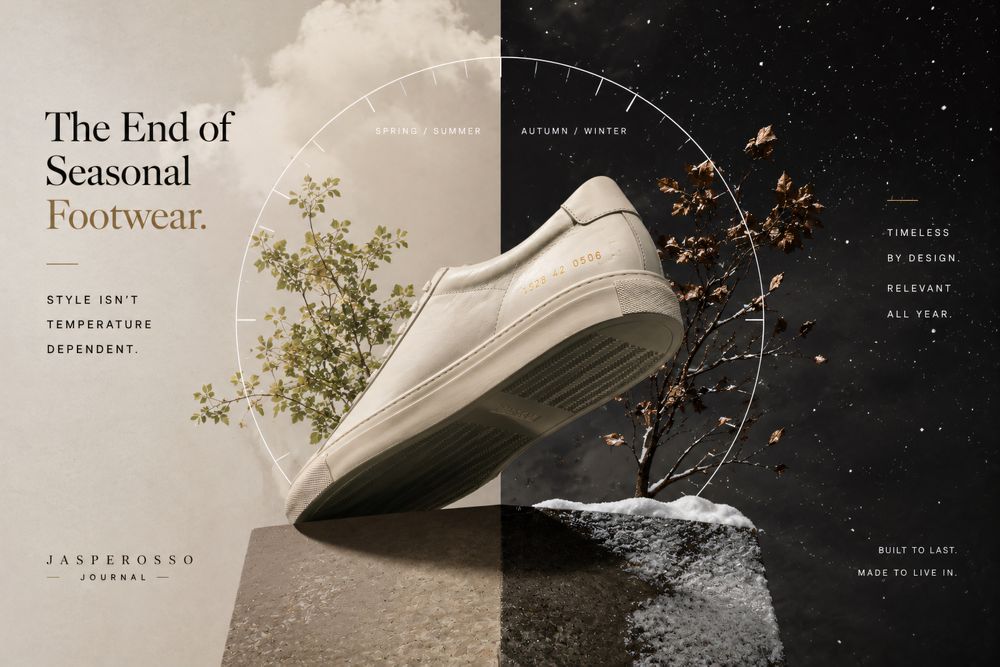
The End of Seasonal Footwear
12th May 2026
Fashion has always liked rules.
Spring/Summer collections arrive with familiar confidence. Autumn/Winter follows with equal predictability. Colours shift. Materials are reassigned. Entire categories of products are quietly moved in and out of relevance according to a calendar that most consumers never consciously agreed to.
And for decades, footwear has followed the same pattern.
Lighter tones for warmer months. Darker shades for colder ones. Minimal designs for spring. Heavier silhouettes for winter. Consumers have been trained to believe that what belongs on their feet should change not because their needs have changed, but because the season has.
But something about that logic is beginning to feel increasingly outdated.
Modern life no longer operates in such neat divisions. Work has become more fluid. Travel is less predictable. Dress codes have softened. Personal style has become less about following seasonal instruction and more about creating consistency.
And yet the footwear industry continues to encourage rotation.
The idea that you should own different pairs of sneakers for different times of year may once have felt practical. Today, it often feels unnecessary.
The most compelling luxury products are not those designed for a quarter. They are designed for years.
That is where the concept of seasonal footwear begins to break down.
For a broader perspective on longevity-led ownership, explore Designed Once, Worn Forever
When Did Shoes Become Weather Dependent?
At some point, footwear stopped being about utility and became about fashion scheduling.
This was not entirely irrational. Certain climates do create legitimate needs. Heavy rain, extreme cold, or technical performance environments naturally require specialised products.
But most daily footwear decisions are not being made in alpine conditions.
For the majority of urban lifestyles, seasonal switching is not driven by necessity. It is driven by expectation.
A clean leather sneaker worn in March is considered appropriate. The same silhouette in October is suddenly treated differently if retail narratives decide it should be.
This is less about practicality and more about conditioning.
Consumers have become accustomed to interpreting products through fashion calendars rather than personal relevance.
Luxury, however, should not operate this way.
True luxury is not built around temporary permission. It is built around permanence.
A beautifully made pair of Italian leather sneakers should not lose relevance because a season changed.
That principle sits at the centre of thoughtful ownership.
Explore the psychology behind consistent ownership in The Ownership Era – Why Modern Consumers Care More About Keeping Than Buying
The Problem With Buying for Three Months at a Time
Seasonal purchasing creates a peculiar kind of waste.
Not necessarily physical waste, although that exists but behavioural waste.
Products bought for narrow windows of relevance spend most of their lives inactive. They are rotated out before they have meaningfully integrated into daily life. They remain relatively unfamiliar. Barely worn. Slightly disconnected from the owner.
This creates an ownership paradox.
Consumers buy more products, but experience each one less deeply.
The emotional relationship never develops.
A sneaker that is worn only during a designated season remains transactional. It fulfils a temporary styling function before being replaced by the next contextual requirement.
By contrast, products worn consistently develop character. Materials soften. Habits form. Comfort becomes instinctive.
The relationship matures.
This is precisely why anti-collection thinking has gained momentum.
The value of a product increasingly lies not in how many versions of it you own, but in how fully one version becomes part of your life.
This shift is explored further in The Anti-Collection – Why One Pair Is Enough
Timeless Design Doesn’t Recognise the Calendar
Some products feel current only because the market tells you they are. Others feel relevant regardless of context. This distinction is design.
Trend-led footwear relies on timing. Oversized soles, aggressively branded panels, loud colour blocking, these are all cues rooted in a specific visual moment.
Once that moment passes, the product often becomes harder to wear. Timeless design behaves differently. Its relevance is not borrowed from trends. It is built into proportion, restraint, and material quality. This is why minimalist luxury footwear remains so compelling.
A clean leather sneaker with balanced proportions and considered detailing does not ask what month it is. It simply works.
Brands like Common Projects built enormous cultural relevance through this exact principle: consistency over reinvention. The same logic applies to custom design.
When creating your own sneaker, seasonal novelty becomes far less attractive than permanent usability.
Colour choices become more restrained. Materials become more intentional. The design becomes less about temporary excitement and more about enduring confidence.
Explore identity led design thinking in How a Sneaker Reflects Your Personality
The Psychology of Seasonal Switching
Seasonal dressing feels natural because it has been normalised.
Retail environments reinforce it constantly. Editorial campaigns shift visual language every few months. Entire product launches are framed around climatic relevance. Over time, this creates unconscious behaviour. Consumers begin rotating not because they need to, but because the rhythm feels familiar. This is behavioural fashion psychology at work.
It mirrors other patterns of conditioned consumption: upgrading devices unnecessarily, refreshing wardrobes prematurely, replacing functional items because cultural cues suggest movement.
Seasonal switching often operates the same way. But once the behaviour is questioned, its logic weakens.
Why should a premium neutral sneaker suddenly feel less appropriate because the weather has cooled slightly?
Why should colour palettes be reassigned according to fashion convention rather than personal style?
Once these questions are asked, the structure begins to unravel.
And in its place emerges something simpler: dressing for lifestyle rather than industry timelines.
Neutral Tones, Permanent Relevance
Colour is one of the strongest drivers of perceived seasonality.
Soft creams become “summer.” Deep browns become “autumn.” Crisp whites are considered spring-adjacent. Rich burgundy somehow becomes weather-specific.
These associations are largely cultural, not functional.
Neutral colour palettes outperform seasonal shades precisely because they avoid over-contextualisation.
A beautifully executed taupe, stone, off-white, espresso, or charcoal sneaker does not belong to a season. It belongs to a wardrobe.
This distinction matters.
Products that integrate widely create longer relevance. Longer relevance creates deeper ownership. Deeper ownership creates greater value.
This is one reason custom made sneakers are uniquely powerful.
Instead of inheriting someone else’s assumptions about seasonality, the wearer chooses a palette aligned with their lifestyle.
The result is footwear designed for continuity.
And continuity is increasingly the defining trait of modern luxury.
Luxury Should Outlast the Season It Was Bought In
Luxury and temporariness make poor partners.
A product positioned as premium but relevant for only a few months creates an uncomfortable contradiction.
True luxury implies durability, not merely physical, but aesthetic.
It suggests confidence in permanence.
A handcrafted leather sneaker made in Italy should not feel disposable because trend momentum changed.
If it does, the problem is rarely craftsmanship. It is design philosophy.
This is why quiet luxury has become such a compelling cultural movement.
Understated products do not require constant reinterpretation. Their restraint protects them from expiry.
They do not compete for seasonal attention.
They integrate.
Explore this philosophy further in Luxury, Not Loud – The Rise of Quiet Customisation
One Pair, Twelve Months
There is increasing elegance in simplicity.
The idea of owning one exceptional pair of sneakers and wearing them across the year would once have been framed as impractical.
Now, it feels intelligent.
Modern luxury consumers increasingly value consistency over novelty. Familiarity over rotation. Versatility over accumulation.
A seasonless sneaker becomes a foundational product.
It simplifies dressing. Reduces friction. Increases emotional attachment.
And crucially, it allows materials to evolve naturally.
Leather develops differently when worn regularly. Fit becomes intuitive. The product begins reflecting its owner.
This relationship cannot develop through occasional use.
That is why longevity and repetition matter.
For a deeper perspective on product ageing, explore What Your Sneakers Will Look Like in Ten Years (If You Bought Well)
Dressing for Lifestyle, Not Fashion Calendars
Fashion calendars were built for retail cycles.
Modern lifestyles are built differently.
Remote work blurred dress codes. Travel patterns shifted. Social environments became more fluid. Formality relaxed.
Consumers increasingly dress according to function, mood, and identity, not editorial instruction.
Seasonless footwear aligns naturally with this evolution.
A versatile sneaker transitions between environments effortlessly. Coffee meetings, weekend travel, city walking, casual evenings, it adapts.
The need for rigid categorisation weakens.
And with it, the logic of seasonal ownership.
This reflects a larger behavioural movement toward intentional dressing.
The question is no longer “what should I wear this season?”
It is “what consistently works for my life?”
That subtle shift changes everything.
Explore the communication power of consistent style in What Your Sneakers Say When You’re Not Speaking
Sustainability Starts With Wearing Things Longer
Sustainability conversations often focus on materials, certifications, and supply chains.
All of these matter.
But behaviour matters just as much.
A product with admirable sourcing but limited usage creates compromised sustainability.
A beautifully made product worn consistently for years creates far stronger value.
Longevity is environmental intelligence.
Seasonless ownership supports this naturally.
When footwear transcends fashion timing, replacement slows. Redundant purchasing declines. Products stay active longer.
This is not performative sustainability.
It is behavioural sustainability.
And increasingly, this is where thoughtful luxury consumers are placing value.
Less noise. Fewer purchases. Better ownership.
The Future Is Seasonless
The future of luxury footwear is unlikely to be louder.
It will likely be quieter, smarter, and more permanent.
Consumers are moving away from overcomplicated ownership models. Seasonal wardrobes feel increasingly inefficient. Trend rotation feels exhausting.
The products gaining relevance are those that simplify rather than complicate.
Footwear that adapts rather than demands.
Design that integrates rather than expires.
This is where customisation becomes especially powerful.
Rather than accepting pre-defined seasonal narratives, consumers design products aligned with their own lifestyle logic.
That is a far more sophisticated expression of ownership.
Conclusion: Beyond Spring/Summer, Beyond Autumn/Winter
Seasonal footwear was built for a different consumer era.
An era of faster fashion cycles. More rigid dress codes. More externally dictated styling behaviour.
That era is changing.
Today’s luxury consumer values permanence. Practical elegance. Products that remain relevant because they were designed intelligently from the beginning.
The most desirable sneakers are no longer those tied to a season.
They are the ones that transcend it.
Because true luxury should never need a calendar.
By Jasper Trumble