


Journal
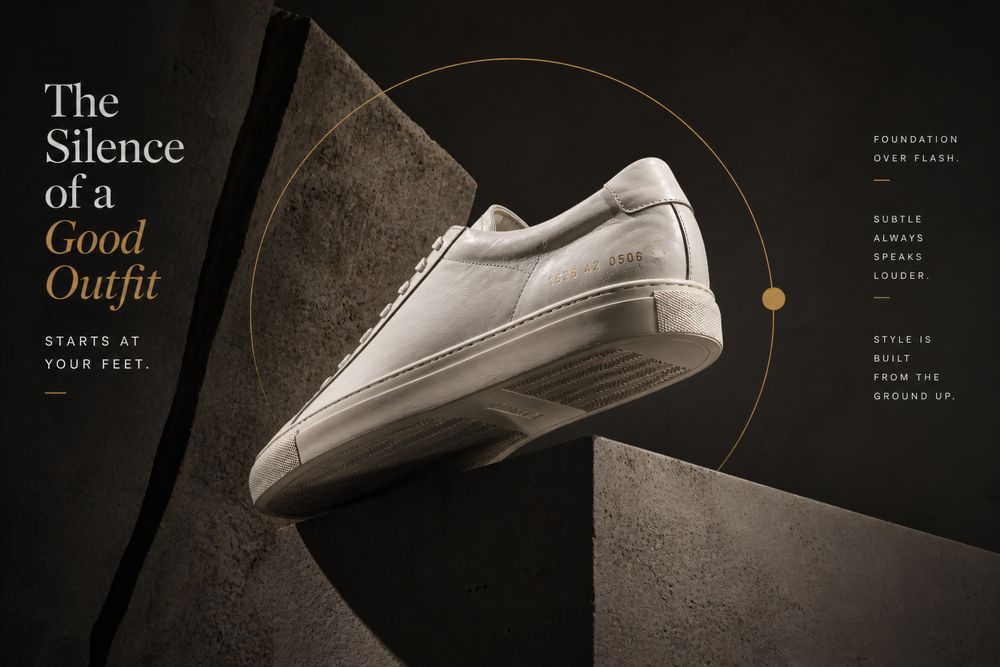
The Silence of a Good Outfit Starts at Your Feet
4th May 2026
There is a quiet difference between an outfit that works and one that tries to. It is rarely obvious at first glance, and almost never defined by a single item. Instead, it reveals itself through balance. Through restraint. Through the absence of anything that feels unnecessary.
The best outfits do not announce themselves. They settle into place.
And more often than not, that sense of cohesion begins at the lowest point, the footwear.
Sneakers are not simply an addition to an outfit. They are its foundation. They determine how everything above them behaves. They influence proportion, tone, and direction. They either stabilise what you are wearing or subtly disrupt it.
This is why the silence of a good outfit starts at your feet.
Explore how ownership and consistency shape style in The Ownership Era – Why Modern Consumers Care More About Keeping Than Buying
Where Every Outfit Really Begins
Most people build outfits from the top down. A jacket, a shirt, a pair of trousers, each selected in isolation before footwear is considered as a final step.
But this approach often creates imbalance.
When sneakers are added at the end, they are forced to adapt to decisions that have already been made. They become reactive rather than foundational. If they do not align perfectly, the entire outfit can feel slightly unresolved.
Building from the ground up changes this dynamic.
Starting with footwear introduces structure early. It defines the tone, casual, refined, understated—before other elements are layered in. It creates a consistent base that everything else can respond to.
This approach reduces friction. It simplifies decisions. And it leads to more cohesive results.
For a deeper look at how repetition strengthens style, explore The Luxury of Familiarity – Why We Wear the Same Sneakers Again and Again
The Foundation Most People Overlook
It is possible to wear well-considered clothing and still feel that something is off. Often, that disruption comes from footwear.
Sneakers carry visual weight. Their shape, colour, and proportion influence how the rest of the outfit is perceived. A bulky silhouette can overpower clean tailoring. An overly bright colour can draw attention away from otherwise balanced elements.
These mismatches are rarely dramatic. They do not ruin an outfit entirely. But they introduce noise.
This is why understated sneakers perform so well. They do not compete. They support. They allow the rest of the outfit to exist without interference.
Minimalist brands such as Common Projects have built their identity around this principle. The design is intentionally restrained, allowing it to integrate seamlessly across different looks.
The result is not absence, but clarity.
Quiet vs Loud: The Decision You Make First
Every outfit makes a choice, whether consciously or not: to be quiet or to be loud.
Footwear is often where this choice is established.
Loud sneakers, defined by exaggerated shapes, heavy branding, or bold colour combinations demand attention. They become the focal point, whether that was the intention or not. Everything else must adjust around them.
Quiet sneakers behave differently. They create space. They allow the outfit to breathe. They contribute without dominating.
This distinction is not about right or wrong. It is about control.
Choosing quiet footwear gives you flexibility. It allows other elements to take precedence when needed, without forcing them to compete. It creates a more adaptable wardrobe.
This aligns closely with the philosophy explored in Luxury, Not Loud – The Rise of Quiet Customisation
The Anchor Effect: Holding an Outfit Together
An outfit without a clear foundation can feel fragmented. Individual pieces may work well on their own, but together they lack cohesion.
Footwear acts as an anchor.
It grounds the outfit visually, providing a point of stability that everything else can relate to. This is particularly important in modern dressing, where silhouettes are often relaxed and layering is more fluid.
A well proportioned sneaker balances volume. It connects the lower half of the outfit to the upper half. It ensures that nothing feels disconnected.
This is not something most people consciously analyse. But it is something they feel.
And when it is missing, the difference is noticeable.
Why Minimal Sneakers Do the Most Work
Versatility is often misunderstood as having more options. In reality, it is about having the right option.
Minimal sneakers excel because they remove limitations. Neutral colours, clean lines, and balanced proportions allow them to function across a wide range of outfits. They do not need to be changed to match the look. They adapt.
This is why a single well-designed pair can outperform multiple alternatives.
It simplifies dressing. It reduces decision-making. It creates consistency.
This idea is explored further in The Anti-Collection – Why One Pair Is Enough
When Shoes Compete, the Outfit Loses
There is a point at which footwear stops supporting an outfit and starts competing with it.
This often happens with overly designed sneakers. Excessive detailing, aggressive silhouettes, or high contrast colour blocking can draw attention away from the overall look.
The result is fragmentation. Instead of a cohesive outfit, there are multiple focal points, each pulling in a different direction.
Restraint avoids this.
By reducing visual noise at the foundation, the outfit becomes more unified. Nothing needs to fight for attention, because nothing is demanding it unnecessarily.
This is where thoughtful design becomes essential. It is not about removing interest, but about placing it correctly.
Dressing from the Ground Up
Changing how you build an outfit changes how it feels.
Starting with footwear introduces discipline. It forces early decisions about tone and direction. It reduces the likelihood of mismatch later.
This approach becomes more effective over time. As a single pair of sneakers is worn repeatedly, it becomes familiar. Reliable. Predictable in the best way.
This consistency allows for faster decisions without sacrificing quality.
It also aligns with a broader shift towards intentional ownership. Fewer items, chosen carefully, used consistently.
To understand how design decisions influence identity, explore What Your Sneakers Say When You’re Not Speaking
The Discipline of Simplicity
Simplicity is often mistaken for lack of effort. In reality, it requires more control.
Choosing minimal footwear is not about avoiding decision making. It is about making better decisions upfront. Selecting something that will continue to work, rather than something that needs to be reconsidered constantly.
This discipline extends beyond footwear. It shapes how the entire wardrobe functions. It reduces excess. It increases clarity.
And over time, it creates a more consistent personal style.
Conclusion: The Power of Starting Quietly
A good outfit does not need to be explained. It does not rely on standout pieces or obvious statements. It works because everything within it aligns.
And that alignment often begins at the foundation.
Sneakers, when chosen well, do not demand attention. They provide structure. They support balance. They allow the rest of the outfit to exist without disruption.
This is what makes them powerful.
Not because they are seen first, but because they hold everything together.
The silence of a good outfit is not accidental.
It is built quietly, from the ground up.

By Katy Trumble