


Journal
Why Real Luxury Rarely Looks New
8th June 2026
There is a peculiar irony at the heart of modern luxury. Consumers spend considerable sums acquiring beautifully made products, only to become anxious the moment those products begin doing exactly what they were designed to do. A crease appears across the toe box of a leather sneaker. A leather bag softens around the edges. A watch develops subtle marks from years of daily wear. Suddenly, concern replaces excitement. The product no longer looks untouched. It no longer looks new.
Somewhere along the way, we have been taught that luxury exists in its most perfect state at the precise moment it leaves the box. Everything that follows is often viewed as a gradual departure from perfection. Ownership becomes preservation. Use becomes a risk. Ageing becomes something to resist.
Yet the finest luxury products have always told a very different story.
True luxury was never designed to remain frozen in time. It was designed to evolve. To settle. To absorb experience. To become more personal with every year that passes. The most compelling products rarely remain unchanged because their value extends beyond craftsmanship alone. Their value emerges through ownership.
This is particularly true of luxury footwear. A handcrafted leather sneaker is not truly finished when it leaves the workshop. The construction may be complete, the stitching flawless, and the materials pristine, but something essential is still missing. The owner has not yet left their mark.
In many ways, the story of luxury begins precisely where the factory ends.
For a broader perspective on long-term ownership, explore → Journal: Designed Once, Worn Forever
The Problem With Perfection
Modern culture has become remarkably obsessed with perfection. Products are photographed before they are used, meals before they are eaten, and destinations before they are experienced. Social media has amplified this tendency, encouraging a world where pristine presentation is often valued more highly than meaningful use.
Luxury has not escaped this mindset. Increasingly, products are admired for their untouched condition rather than their lived experience. The immaculate sneaker becomes more desirable than the well-loved one. The untouched leather bag somehow appears more valuable than the bag that has travelled the world.
The logic seems understandable at first glance. New products are visually impressive. They possess a kind of flawless certainty. Nothing has been tested. Nothing has been challenged. Nothing has yet revealed weakness.
But perfection is often surprisingly uninteresting.
An untouched sneaker tells us almost nothing. It reveals no history, no personality, and no evidence of a life being lived. It may be technically flawless, but it is emotionally blank. The product exists exactly as it did when it left the workshop, carrying none of the individuality that ownership creates.
This is one of the great misunderstandings of luxury. Perfection is not the end goal. It is simply the starting point.
The finest products are not admired because they remain unchanged. They are admired because they change beautifully.
Luxury Was Never Meant to Stay in the Box
Few modern phenomena illustrate this contradiction more clearly than the rise of “deadstock” culture. Entire collections of sneakers remain unworn, preserved in their original condition, admired largely because they have avoided fulfilling their intended purpose.
From a collector’s perspective, the appeal is understandable. Scarcity creates value. Preservation protects rarity. Yet from the perspective of craftsmanship, the concept becomes rather peculiar.
A luxury sneaker is not merely an object. It is the result of countless decisions made by designers, pattern makers, leather cutters, stitchers, and artisans. Every material has been selected with use in mind. The leather is intended to soften. The lining is intended to adapt. The shape is intended to become familiar.
To keep such a product permanently untouched feels strangely incomplete.
It is rather like purchasing a grand piano and refusing to play it because the keys might wear. The object remains beautiful, certainly, but much of its purpose is left unexplored.
Luxury craftsmanship exists to be experienced. Ownership is not something that happens after the product is finished. Ownership is part of the product itself.
For a deeper look at craftsmanship and the people behind it, explore → Journal: Meet the Makers – The Artisans Behind Your Sneakers
When Leather Begins to Tell the Truth
One of the reasons leather remains central to luxury footwear is that it tells the truth.
Initially, a leather sneaker appears relatively uniform. The surfaces are clean, the colour is consistent, and the silhouette feels precise. Everything looks exactly as intended.
Then ownership begins.
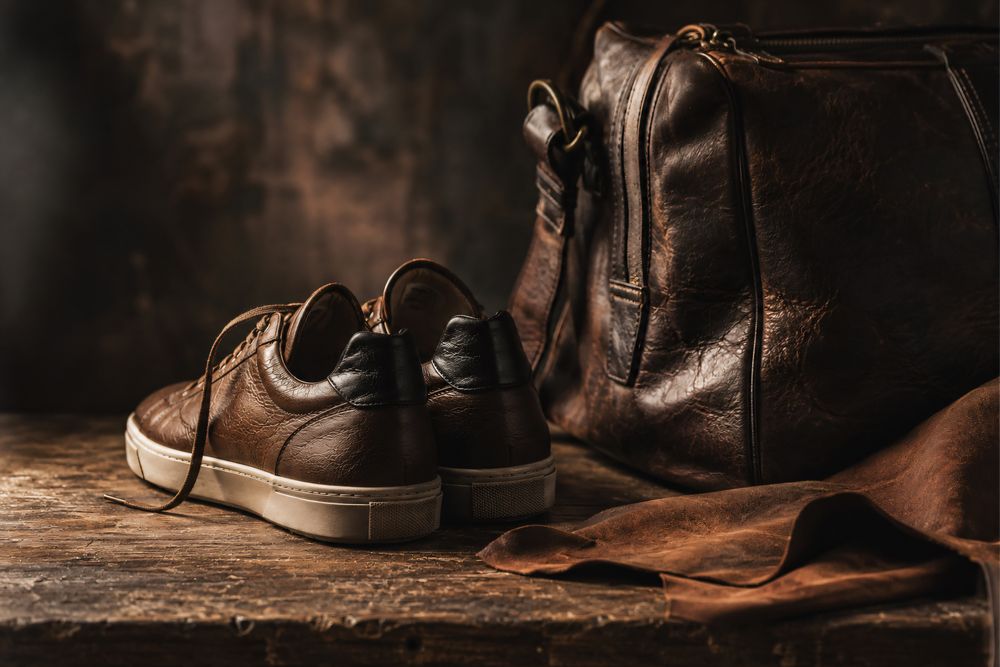
Gradually, subtle changes emerge. Creases develop where the foot naturally flexes. Areas of frequent contact become slightly richer in tone. The leather softens and responds to movement. The product starts reflecting the habits of the individual wearing it.
This is where leather becomes truly interesting.
Unlike synthetic materials that often attempt to resist visible change for as long as possible, leather embraces evolution. Its appeal is not diminished by use. It is enhanced by it.
Every crease becomes evidence of movement. Every softened edge reflects familiarity. Every subtle variation in colour represents time spent living rather than preserving.
This is one of the reasons leather continues to dominate luxury categories despite decades of technological innovation.
Explore this idea further in → Journal: Why Leather Still Wins (Despite Everything)
The beauty of leather lies in its honesty. It does not conceal ownership. It celebrates it.
The Difference Between Worn and Used Up
Of course, it is important to distinguish between ageing and deterioration.
The two are often confused, particularly in a culture accustomed to replacing products at the first sign of wear. Yet they are fundamentally different experiences.
A product that is worn has developed character. A product that is used up has exhausted its usefulness.
Luxury products are designed to age. They are not designed to deteriorate.
A leather sneaker that develops patina, softness, and individuality is ageing. A poorly made sneaker that cracks, peels, and collapses is deteriorating.
The distinction lies in quality.
Well-made products improve because their materials improve. Poorly made products decline because their materials have nowhere to go except failure.
This difference becomes increasingly apparent over time. A premium leather sneaker often looks more compelling after several years than it did when it was new. The shape becomes familiar. The leather gains depth. The overall appearance becomes more personal.
Ageing becomes an enhancement rather than a problem.
Why Newness Is Often the Least Interesting Stage
There is a compelling argument that the most expensive stage of a luxury product is often the least interesting one.
When a sneaker is brand new, it possesses potential. What it lacks is history.
History is where emotional value emerges.
A leather travel bag becomes interesting because of the journeys it has witnessed. A mechanical watch becomes meaningful because of the years it has accompanied its owner. A luxury sneaker becomes distinctive because it has adapted to a particular life.
Newness offers possibility.
Ownership delivers meaning.
This is why some of the most admired luxury products in the world are not admired despite their age, but because of it. The passage of time adds something that craftsmanship alone cannot provide.
It adds narrative.
For a deeper exploration of long-term wear, explore → Journal: What Your Sneakers Will Look Like in Ten Years (If You Bought Well)
The End of the Deadstock Mentality
There are growing signs that attitudes towards ownership are beginning to change.
Consumers are becoming increasingly sceptical of constant replacement cycles. Trends arrive faster than ever, yet satisfaction often disappears just as quickly. The excitement of acquisition has become easier to achieve and harder to sustain.
As a result, permanence is becoming attractive again.
Products that remain relevant. Products that improve with use. Products that reward long-term ownership rather than demanding constant replacement.
This shift reflects a broader movement away from accumulation and towards appreciation. Consumers increasingly value the things they keep rather than the things they acquire.
That change has profound implications for luxury footwear.
The question is no longer how many sneakers someone owns. It is how deeply they engage with the ones they choose to keep.
For a broader perspective on this shift, explore → Journal: The Anti-Collection – Why One Pair Is Enough
What Time Adds That Money Cannot Buy
Money can purchase craftsmanship.
Money can purchase materials.
Money can purchase exclusivity.
What money cannot purchase is history.
History must be earned.
The relationship between a product and its owner develops slowly, through repetition and familiarity. It cannot be accelerated. It cannot be outsourced.
This is what makes long-term ownership so valuable.
Over time, products become associated with places, people, routines, and memories. They accumulate significance beyond their physical form.
A sneaker worn on important journeys becomes more than a sneaker. It becomes part of a personal story.
This is one reason luxury products often become more meaningful as they age. The object itself may remain largely unchanged, but its emotional significance grows continuously.
Patina: Luxury’s Invisible Signature
Patina is one of the most misunderstood concepts in luxury.
To some, it appears to be wear. To others, it appears to be imperfection.
In reality, patina is evidence of life.
It is the visible record of ownership.
Unlike damage, which detracts from a product, patina contributes to its individuality. It transforms something generic into something unique. No two products develop exactly the same patina because no two owners live exactly the same life.
This individuality is enormously valuable.
In a world increasingly dominated by uniformity, patina creates distinction.
It becomes a signature written not by the manufacturer, but by the owner.
The Beauty of Things That Have Been Lived In
Modern luxury is gradually moving away from flawless perfection and towards authenticity.
Consumers increasingly value products that feel real rather than manufactured, personal rather than generic, familiar rather than pristine.
This is not a rejection of craftsmanship. It is an appreciation of what happens after craftsmanship.
The most beautiful products often carry visible evidence of life. They feel integrated into their owner’s world rather than preserved outside it.
Luxury is becoming less about possession and more about participation.
This shift reflects a growing appreciation for depth over novelty, permanence over excitement, and ownership over acquisition.
For a broader perspective on meaningful ownership, explore → Journal: The Ownership Era – Why Modern Consumers Care More About Keeping Than Buying
True Luxury Settles, It Doesn’t Shine
Perhaps the most important thing to understand about luxury is that its appeal often deepens quietly.
It does not demand attention. It does not rely on constant novelty. It does not need to remain untouched to remain valuable.
Instead, it settles.
The leather softens. The colours deepen. The product becomes more familiar, more personal, and more distinctive.
This is why real luxury rarely looks new.
Newness is fleeting. Character is enduring.
The finest sneakers, watches, bags, and leather goods are not defined by their perfection on day one. They are defined by how beautifully they evolve over the years that follow.
Because true luxury is not about resisting time.
It is about allowing time to become part of the design.
By Jasper Trumble