



Journal
Why good design becomes almost invisible
The products that work best are often the ones we notice least
30th October 2026
There is a curious contradiction at the heart of good design. We admire it, pay a premium for it, discuss it at considerable length and occasionally travel halfway across the world to experience it. Yet when design is genuinely exceptional, we often stop noticing it altogether.
Consider the door handle you use without thinking, the chair you can sit in for hours without adjusting your position, or the leather bag that always seems to contain exactly what you need, precisely where you expect to find it. These objects rarely interrupt your day to remind you how cleverly they have been designed. They simply work, which is perhaps the least theatrical compliment imaginable.
The same principle applies to clothing. A beautifully cut jacket can make someone look effortlessly well dressed without attracting attention to its construction. A pair of carefully designed leather sneakers can feel so natural that the wearer stops thinking about their feet entirely. The proportions, materials and construction are doing their jobs, but the owner is occupied with something considerably more interesting than analysing them.
We tend to associate luxury with visibility. We imagine objects that demand attention, impressive interiors, elaborate detailing and products whose value can be recognised from across a room. Yet some of the most sophisticated expressions of luxury are almost impossible to demonstrate in a photograph. They are experienced through the absence of irritation, the removal of unnecessary decisions and the quiet confidence that everything will behave as expected.
This is not the same as saying that good design should be boring, anonymous or devoid of personality. A beautiful object can still inspire admiration. A distinctive piece of furniture can become the focal point of a room, just as an individually designed pair of sneakers can express a particular sense of style. The distinction lies in what happens after the initial impression. Does the object continue demanding attention, or does it settle naturally into the life of the person using it?
That question reveals a great deal about the difference between design that looks impressive and design that has been properly resolved.
Perhaps the greatest achievement of a designer is not creating something that makes people constantly think about design. It is creating something that allows people to forget about it.
1. The Best Design Removes Problems You Never Knew You Had
Most people do not begin their day thinking about product design. They make coffee, get dressed, find their keys, leave the house and proceed through a sequence of familiar activities. Throughout this process, they interact with dozens of designed objects, almost all of which are expected to behave without explanation.
We notice design most readily when those expectations are violated. A door that appears to require pushing but actually needs pulling. A kitchen tap whose controls make no intuitive sense. A hotel shower that demands the intellectual commitment normally associated with learning a new language. These experiences are memorable precisely because they interrupt activities that should require almost no conscious effort.
Good design anticipates how people are likely to behave and makes the appropriate action feel natural. The position of a handle suggests how it should be used. The shape of a chair accommodates the body. The layout of a familiar device makes important functions easy to locate. The user does not need to admire the designer’s ingenuity because the design has removed the need for ingenuity on the user’s part.
This is one of the central ideas in human-centred design: successful products are developed around people’s capabilities, expectations and real-world behaviour rather than merely around what can be manufactured or made visually interesting. The result is not necessarily simplicity in appearance. It is simplicity in experience.
There is an important distinction between something that is easy to understand and something that has been easy to design. Achieving an intuitive result can require extensive observation, experimentation and refinement. A complicated mechanism may be necessary to create an uncomplicated interaction. The engineering can be sophisticated precisely so that the experience does not have to be.
Luxury brands sometimes overlook this distinction. They may concentrate on demonstrating complexity, craftsmanship or technological achievement when the customer would benefit more from having those qualities translated into an effortless experience.
The most impressive product is not always the one with the greatest number of features. Sometimes it is the one that removes the greatest number of small frustrations from everyday life.
2. Why We Only Notice Comfort When It Disappears
Comfort is one of the most important and least glamorous aspects of good design. It rarely provides the dramatic visual impact associated with luxury advertising, and it is difficult to communicate convincingly through photographs. Yet it can determine whether a beautifully made object becomes a favourite or remains an expensive reminder of an optimistic purchasing decision.
Consider the experience of sitting in a poorly designed chair. At first, the problem may be barely noticeable. After twenty minutes, you begin adjusting your position. After an hour, you are negotiating with the furniture, attempting to discover an arrangement that will allow you to remain seated without developing a personal grievance against its designer.
A genuinely comfortable chair produces a different experience. You sit down, settle into position and concentrate on whatever brought you there. The chair disappears from conscious attention because it is supporting the activity rather than competing with it.
Footwear operates in much the same way. An uncomfortable shoe makes its presence known repeatedly. The wearer becomes aware of pressure, friction, inadequate support or an unsuitable fit. Walking stops being an automatic activity and becomes something requiring small, continuous adjustments.
A comfortable shoe does the opposite. It allows the wearer to concentrate on the journey, the conversation or the day ahead. The absence of discomfort becomes the defining quality, although it may never be consciously acknowledged.
This is why the relationship between footwear and movement deserves more attention than it usually receives. As explored in The Psychology of Wearing: How Your Shoes Influence How You Move Through the World, what we wear can influence confidence, behaviour and our experience of everyday activities.
Comfort is not determined by one feature alone. In footwear, fit, materials, construction, sole characteristics and individual anatomy all contribute to the result. A beautifully made sneaker can still be unsuitable for a particular foot, just as an exceptionally designed chair may not accommodate every body equally well.
This is an important qualification because good design does not mean pretending that universal solutions exist. It means understanding the intended user and making appropriate decisions about the experience the product should provide.
The highest compliment for comfortable footwear may be that, after a long day, its owner has barely thought about it.
3. Proportion Is the Silent Architecture of Beautiful Objects
Some objects look immediately right without offering an obvious explanation. A watch sits naturally on the wrist. A jacket falls cleanly across the shoulders. A chair appears perfectly balanced within a room. A leather sneaker possesses an elegance that seems disproportionate to its relatively simple construction.
Much of this impression comes from proportion.
Proportion concerns the relationship between different parts of an object. It determines how elements interact, how visual weight is distributed and whether the finished design feels coherent. A product may use exceptional materials and sophisticated manufacturing techniques, yet appear awkward because its proportions have not been resolved.
In footwear, small differences can have a substantial visual effect. The shape of the toe, the height of the sole, the position of the eyelets and the relationship between the upper and heel all contribute to the overall silhouette. A sneaker can become visually heavy through an unnecessarily substantial sole or appear unbalanced because a decorative panel interrupts the intended lines.
The difficulty is that good proportion rarely attracts attention to itself. We recognise the result rather than the individual decisions that produced it. The eye moves naturally across the object because nothing appears misplaced.
This is closely connected to The Last 5% Is Where Luxury Lives, which examines how apparently insignificant refinements can transform the experience of a product. The relationship between components often matters more than the individual components themselves.
Proportion also influences longevity in a stylistic sense. Designs dependent upon exaggerated shapes or temporary visual trends can become closely associated with a particular moment. More balanced proportions may remain appealing across changing fashions because their visual relationships feel considered rather than deliberately provocative.
That does not mean every well-designed product should be conservative. Dramatic proportions can be entirely appropriate when they serve a coherent design intention. The issue is whether those decisions create a successful whole or merely generate attention.
The most accomplished designers understand that the eye is remarkably sensitive to imbalance, even when the observer cannot identify its cause. They refine the relationships until the object appears natural, then resist the temptation to add something unnecessary.
The result is often described as effortless. As with most things described that way, considerable effort may have been involved.
4. Intuitive Design Is Really About Respecting People’s Time
There is an increasingly valuable form of luxury that has very little to do with expensive materials: the absence of unnecessary effort.
We live surrounded by products and services that require decisions, passwords, instructions, updates, comparisons and occasional conversations with customer-service departments. Even simple activities can become complicated when designers prioritise features, novelty or internal business requirements over the needs of the person using the product.
An intuitive experience respects the user’s time by removing unnecessary complexity.
Consider a beautifully designed hotel room. The lighting controls are where you expect them to be. The wardrobe opens naturally. There are enough accessible sockets, the bathroom functions without explanation and the room temperature can be adjusted without consulting a laminated instruction card. None of these details is especially glamorous, yet together they can make the difference between a pleasant stay and an irritating one.
The same principle applies to digital experiences. A website should make it clear where to begin, what choices are available and how to complete an intended action. If a customer must repeatedly stop to work out what happens next, the design is imposing a cost in attention and effort.
This becomes particularly relevant when purchasing personalised products. Customisation offers creative freedom, but freedom becomes less enjoyable when the process is confusing. Customers should be able to understand their options, see the consequences of their decisions and move through the experience with confidence.
Jasperosso’s three dimensional design studio exists within this relationship between creative possibility and usability. It allows customers to explore combinations of leather, colour, texture, laces, eyelets and lining while viewing the evolving sneaker design. The technology is useful because it gives physical form to decisions that might otherwise be difficult to imagine.
The important point is not that the experience uses three-dimensional technology. It is that the technology can make an individual design process more understandable and accessible.
This relationship between digital tools and personal expression is explored in From Screen to Street: How Digital Design Has Changed What We Expect to Wear. The most successful digital experiences are not necessarily those that demonstrate the greatest technological sophistication. They are those that help people achieve something meaningful without making the technology itself an obstacle.
Good usability is a form of consideration. It acknowledges that the customer’s attention is valuable and should not be wasted solving problems the designer could have resolved.
5. Visual Restraint Allows the Important Things to Be Seen
One of the most difficult decisions in design is knowing when to stop. There is nearly always another detail that could be added, another material that could be introduced or another feature that might make the product appear more distinctive.
The temptation is understandable. Additional elements provide visible evidence of creative effort. They can make a product easier to describe, easier to differentiate and occasionally easier to sell. Yet they can also undermine the qualities that made the original design appealing.
Visual restraint requires the designer to distinguish between elements that contribute to the experience and those that merely attract attention.
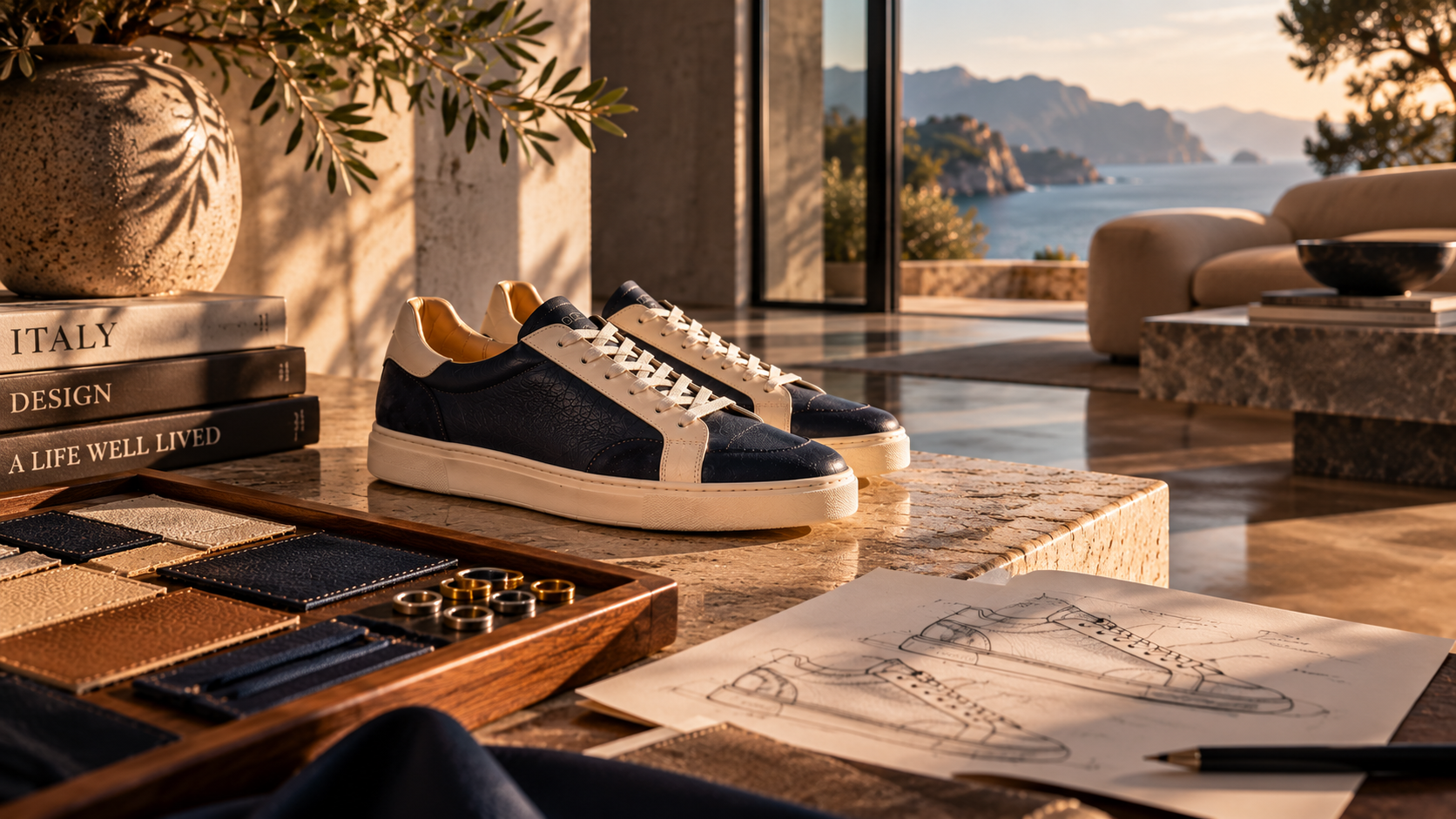
A well-cut jacket does not necessarily benefit from additional pockets, contrasting stitching or decorative buttons. A beautifully proportioned chair may become less elegant when its structure is unnecessarily complicated. A leather sneaker with a strong silhouette and carefully selected materials may lose its refinement when too many panels, textures and colours compete for attention.
This is not an argument for eliminating personality. A restrained design can be distinctive, expressive and memorable. The difference is that its character emerges from a coherent relationship between elements rather than from the accumulation of decorative features.
The subject is explored in The Beauty of Restraint, where editing becomes a central part of creative judgement. Removing something can require more confidence than adding it because the improvement may be difficult to demonstrate independently.
There is also a practical advantage to visual restraint. Products with fewer unnecessary details can be easier to understand, style and integrate into everyday life. A beautifully balanced leather sneaker may work with tailoring, denim and relaxed weekend clothing without requiring the rest of the outfit to accommodate its design.
This versatility can become particularly valuable over time. An object that remains visually appropriate across different settings is more likely to be used regularly, and repeated use is often where the deepest satisfaction develops.
The best restrained designs do not feel empty. They feel complete. Every visible element has a reason to exist, and nothing appears to have been included simply because space was available.
6. The Invisible Work Behind an Effortless Experience
There is a persistent misunderstanding that simple products must be simple to create. In reality, removing complexity from the user’s experience can require considerable complexity behind the scenes.
A beautifully functioning mechanical watch contains an intricate relationship between components that the wearer may never examine. A well-designed car incorporates engineering decisions intended to make driving feel predictable and controlled. A comfortable shoe depends upon the successful integration of materials, pattern design, construction and fit.
The customer experiences the result, not the accumulated decisions.
This is where craftsmanship becomes especially relevant. Skilled makers develop an understanding of materials and processes that allows them to anticipate problems before they become visible. They recognise how leather behaves, how components should align and which details require additional attention.
The value of this knowledge is not always obvious in the finished object. A seam that lies flat, a lining that feels comfortable or an upper that retains its intended shape may appear unremarkable precisely because the construction has been properly executed.
The relationship between human skill and technology is explored in Why Handmade Still Matters in an Automated World. Modern tools can support consistency and precision, but material understanding and judgement remain important wherever products must respond to physical variation and practical constraints.
For leather footwear, the design process must reconcile appearance with movement. A material that looks beautiful in isolation must also behave appropriately when incorporated into the shoe. Decorative elements must work with the underlying construction. The finished product must retain its intended character while accommodating the realities of use.
These requirements are not especially romantic, which may explain why they receive less attention than photographs of leather hides and traditional workshops. Yet they are central to the experience of ownership.
A product should not require the customer to understand the technical decisions behind it. The maker’s responsibility is to resolve those decisions so that the owner can simply enjoy the result.
When this happens, craftsmanship becomes almost invisible. Its presence is revealed not through constant attention, but through the absence of problems that less considered construction might have created.
7. Good Design Understands the Difference Between Choice and Complexity
Choice is often presented as an unquestionable benefit. More colours, more materials, more features and more combinations are assumed to produce a better customer experience. Yet anyone who has spent an unreasonable amount of time selecting something as mundane as a television subscription will recognise that additional options do not always make decisions easier.
Choice can be empowering, but it can also become exhausting.
The challenge for designers is to provide meaningful freedom without requiring customers to become experts in every available possibility. This is particularly relevant to personalised products, where the attraction lies in creating something individual rather than selecting a predetermined design.
A customer choosing the colour and texture of leather for a pair of sneakers may enjoy exploring different combinations. However, the process becomes less satisfying if the options are poorly organised, the visual result is difficult to understand or the relationship between different materials remains unclear.
The design of the experience therefore matters as much as the number of available choices.
A well-considered customisation system should make exploration feel natural. It should help customers understand how different selections work together and allow them to refine their preferences without unnecessary confusion. The technology should support creativity rather than become the principal subject of attention.
There is also an important distinction between personalisation and complexity in the finished product. A customer may have many decisions available during the design process while ultimately creating something visually restrained.
Indeed, the ability to choose precise materials and colours can make subtle design more satisfying. A particular shade of navy, a carefully selected suede texture or a contrasting lining may be personally meaningful without making the finished sneaker conspicuous.
This relationship between individual choice and understated design is examined in Luxury, Not Loud: The Rise of Quiet Customisation. Personalisation does not have to produce an object that announces its uniqueness. Sometimes its greatest achievement is creating something that feels unusually appropriate to the person who owns it.
The designer’s responsibility is to make that process accessible. The customer’s responsibility is simply to decide what they like.
When the experience is properly resolved, the number of decisions may be substantial, but the process should not feel unnecessarily complicated.
8. Why Familiarity Can Be the Greatest Compliment
New products attract attention because they are unfamiliar. We examine their appearance, explore their features and compare them with previous experiences. Over time, however, that attention usually diminishes.
This is often interpreted as a loss of excitement, but it can also represent the development of a successful relationship between owner and object.
A favourite leather bag becomes familiar through repeated use. The owner knows how it opens, where its contents belong and how it feels when carried. A watch becomes a natural presence on the wrist. A well-designed pair of sneakers becomes an instinctive choice because the wearer understands their comfort, appearance and versatility.
The object has moved beyond novelty into trust.
This process is explored in The Luxury of Familiarity: Why We Wear the Same Sneakers Again and Again. Repeatedly choosing the same possession can demonstrate satisfaction rather than a lack of imagination.
There is an important psychological distinction between familiarity that produces affection and familiarity that merely produces habit. We can continue using poorly designed products because replacing them requires effort. The fact that something has become familiar does not automatically make it good.
The more revealing question is whether we would choose it again.
A genuinely successful design continues to justify itself even when alternatives are available. Its owner understands its strengths, accepts its limitations and finds that the overall experience remains preferable to the uncertainty of something new.
This is particularly relevant to luxury, where the excitement of acquisition can sometimes overshadow the quieter pleasures of ownership. A product that remains satisfying after hundreds of uses has demonstrated something that cannot be established through advertising alone.
Perhaps the most meaningful compliment is not that an object continues attracting attention, but that it continues being chosen after attention is no longer necessary.
9. The Most Sophisticated Technology Knows When to Disappear
Technology has transformed the way products are designed, manufactured, presented and purchased. Digital modelling allows complex forms to be explored before production. Manufacturing equipment can support precision and consistency. Interactive tools give customers opportunities to participate in decisions that were previously controlled entirely by manufacturers.
These developments can be valuable, but technological sophistication is not the same as good design.
A product can contain impressive technology while remaining difficult to use. A website can offer elaborate visual effects while making simple tasks unnecessarily complicated. A customisation system can demonstrate extraordinary technical capability yet leave customers uncertain about the decisions they are making.
The most successful technology supports the intended experience rather than competing with it.
Consider the navigation system in a modern car. Its purpose is not to remind the driver how sophisticated the software has become. It is to provide useful information at the appropriate moment, allowing the driver to concentrate on reaching the destination. When the system is intuitive, much of its underlying complexity becomes irrelevant to the person using it.
The same principle applies to digital product design.
A three dimensional sneaker configurator is valuable because it allows customers to see how their choices affect the finished design. Its success should be measured by how confidently people can explore their preferences and understand the result, not simply by the sophistication of the underlying technology.
For Jasperosso, the relationship between digital design and Italian craftsmanship is a useful illustration. The design studio provides an accessible way for customers to express their preferences, while the physical product is handcrafted in Le Marche. The technology facilitates the decisions; the craftsmanship gives them tangible form.
Neither stage should need to dominate the customer’s experience.
This does not mean technology must be hidden or deliberately understated. Customers may enjoy exploring an innovative design studio, just as they may appreciate the engineering behind a mechanical watch. The distinction is that understanding the technology should be optional rather than necessary for enjoying the result.
Good technology expands what people can do while reducing the effort required to do it. Its sophistication is demonstrated through usefulness rather than spectacle.
10. When Nothing Feels Wrong, Everything Feels Right
One of the difficulties of discussing exceptional design is that its most valuable qualities are often expressed through absence. There is no discomfort, no confusion, no awkward proportion, no unnecessary detail and no recurring irritation.
The product simply behaves as expected.
This can make good design surprisingly difficult to market. It is much easier to photograph a dramatic feature than to demonstrate the absence of friction. A striking colour combination is immediately visible, while the comfort of a carefully considered lining may only become apparent after hours of wear.
Yet these quieter qualities often determine whether a product becomes a lasting favourite.
A well-designed chair allows us to enjoy a conversation without thinking about our posture. A beautifully organised kitchen makes preparing a meal feel natural. A comfortable pair of leather sneakers allows us to move through the day without repeatedly considering what is happening beneath our feet.
The relationship is explored in Luxury Is What You Stop Thinking About, where dependable objects become valuable partly because they remove small demands on our attention.
This is not a call for design to become entirely invisible in appearance. Beauty matters. Individuality matters. The pleasure of owning something distinctive and carefully made is a legitimate part of luxury.
But those qualities should coexist with usability rather than undermine it.
An exceptional product can be visually compelling when first encountered and quietly dependable thereafter. It can reward close inspection without demanding constant attention. It can express personal taste while remaining comfortable, functional and appropriate for everyday life.
Perhaps that is the highest level of design maturity: understanding that the object is not the centre of the owner’s world. It exists to contribute to a life already filled with experiences, responsibilities, relationships and interests.
The best designers recognise this. They do not expect people to spend their days admiring every detail of a product. They create something sufficiently well considered that the owner can enjoy everything else.
Conclusion: The Quiet Intelligence of Things That Simply Work
We often judge design by what we can see. We admire the silhouette of a chair, the proportions of a watch, the lines of a car or the combination of materials in a beautifully made pair of sneakers. These qualities matter, and they can provide enormous pleasure.
Yet the deepest satisfaction frequently comes from what we do not notice.
We do not notice the awkward seam because it is not there. We do not think about the chair because it remains comfortable. We do not struggle with the controls because their purpose is immediately apparent. We do not spend the day adjusting our footwear because the fit and construction allow us to concentrate on something else.
These absences are not accidental. They are often the result of careful observation, thoughtful design and numerous small decisions made long before the customer encounters the finished product.
This is why good design becomes almost invisible. It removes unnecessary demands on our attention while allowing the qualities that matter to remain.
For luxury brands, the lesson is significant. Exceptional materials, craftsmanship and innovative technology should contribute to a better experience of ownership rather than simply providing impressive claims. The objective is not merely to persuade customers that something is beautifully designed, but to ensure that its beauty is supported by comfort, usability and lasting relevance.
For Jasperosso, this means recognising that the customer’s experience extends beyond the initial excitement of designing a pair of personalised Italian leather sneakers. The design studio should make creative decisions enjoyable and understandable. The finished sneakers should translate those choices into a coherent product that feels natural to wear and easy to incorporate into everyday life.
The most meaningful result is not necessarily a customer who spends every day admiring the construction of their shoes. It is someone who reaches for them instinctively, enjoys wearing them and gradually comes to regard them as an indispensable part of their wardrobe.
There is something quietly satisfying about that progression. An object begins as a carefully considered design, becomes a desirable purchase and eventually settles into the background of everyday life. Its qualities have not disappeared. They have become familiar enough that they no longer require conscious attention.
Perhaps that is the distinction between design that merely impresses and design that genuinely improves our lives. The first asks us to notice it. The second gives us the freedom to notice everything else.
And perhaps the greatest achievement of good design is not making itself unforgettable, but making the experience of using it so natural that we forget the design was ever there at all.
By Jasper Trumble